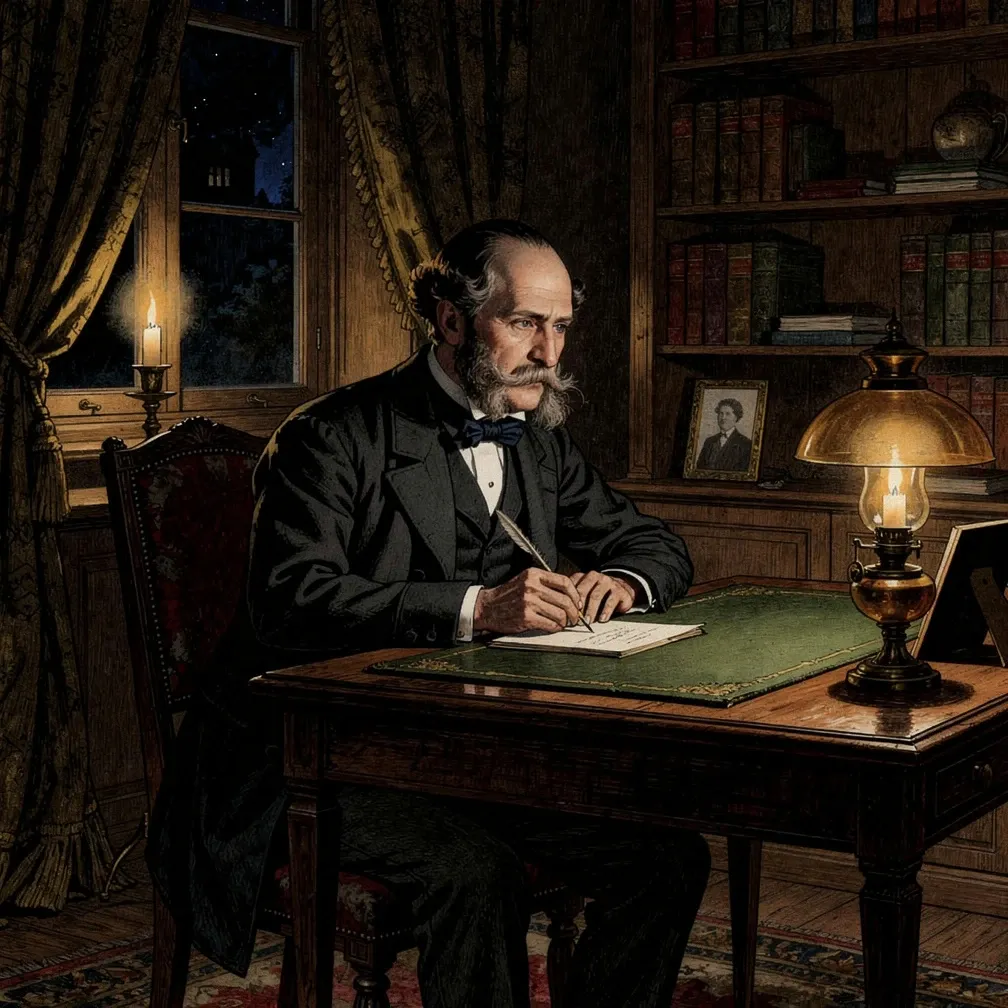
On the Matter of His Royal Highness the Prince of Wales
Private memorandum — Prince Albert Windsor Castle, October 1861
I set down these observations for my own use and clarity of thought. They are not intended for communication. I write because the alternative is to carry the matter unexamined, and I have never been able to do that.
The facts, as I have now confirmed them through three independent sources, are these. During his attachment to the Grenadier Guards at the Curragh Camp in the County of Kildare this past summer, the Prince of Wales entered into a liaison of a sexual character with a young woman of the theatre, one Miss Clifden. The liaison was not a matter of chance encounter. It was arranged — I use the word precisely — by officers of the regiment who considered it an entertainment. The young woman was brought to the Prince's quarters after dark. The arrangement was repeated on subsequent evenings. The affair has since become a subject of open conversation in certain London clubs, and I am informed that Miss Clifden has herself made no particular secret of the connexion.
I state these facts without elaboration because I do not wish to dwell on them longer than is necessary to establish what has occurred. I state them also because I am aware of a temptation, in the first shock of such intelligence, to diminish what has happened — to treat it as an episode of youthful indiscretion, as the kind of thing that is understood to happen among young men of a certain station, as a matter that is regrettable but not serious. I wish to record, clearly and while the facts are fresh, that I do not regard it in that light. I do not regard it in that light at all.
What has happened is not that a young man has yielded to temptation. Young men yield to temptation. I am not so removed from the world as to be astonished by that. What has happened is that the heir to the throne of this country was delivered, by men who had been charged with his formation, into a situation deliberately contrived for his moral corruption — and that he permitted it. He did not resist. He did not remove himself. He did not report the conduct of the officers involved. He participated, and he did so on more than one occasion, which removes the defence of impulse and replaces it with the fact of choice.
I have spent twenty years preparing this boy for the weight he must one day carry. Twenty years. The Queen will confirm the figure. From the age of seven he has had the finest tutors in the kingdom. He has had a curriculum designed — I designed it myself — to produce in him the qualities of mind and character that a constitutional monarch requires: judgement, self-command, a sense of obligation to something larger than his own comfort. He has had, in short, every advantage that a father's care and a nation's resources could provide. And at the first real test of his character — not an examination, not an intellectual exercise, but a test of who he is when no one he respects is watching — he failed. He failed completely.
I do not write this in anger. I have been angry, and the anger has passed, and what remains is something I find more difficult to manage. Anger can be answered. What remains is a kind of clarity that I did not want and cannot put aside. I see now — and I record it because I must be honest with myself even where I have not been successful — that the programme I devised for him was addressed to a boy who does not exist. I designed an education for a mind that was serious, or could be made serious. What I have is a boy who is amiable. Amiable and weak. He is not vicious. I acquit him of vice, properly understood. He has no cruelty in him and no malice. He is warm-hearted and he means well. These are real qualities and I do not diminish them. But they are the qualities of a country gentleman, not a king. A king must be able to stand alone in a room with a decision that no one else will make for him, and Bertie cannot do that. He bends. He bends toward whatever force is nearest, and at the Curragh the nearest force was a group of young officers who thought it amusing to debauch the heir to the Crown.
The institutional implications I can state briefly. If this affair becomes a matter of public scandal — and I cannot be confident that it will not — it will do damage of a kind that no amount of management can fully repair. A Prince of Wales whose private conduct is known to be dissolute is a Prince of Wales who cannot command the moral authority that the monarchy requires. The institution survives on the understanding — not always justified, but necessary — that the sovereign and the heir are persons of serious character. This is not a sentimental principle. It is a political one. The republican interest in this country, which is not negligible, requires no better ammunition than a prince who is seen to behave as his critics expect.
Even if the affair is contained — and I am taking steps toward that end — the damage within this household is done. The Queen knows. I have told her, because she has a right to know and because concealment is not a principle I have ever practised with her. Her reaction has been severe. She is a woman of strong feeling and she takes this as a betrayal not merely of our family's standards but of her own person. I fear that she will not forgive him readily, and I am not in a position to counsel forgiveness when I have not achieved it myself.
I must ask myself what is to be done. The answer, which I find bitter, is that there is very little to be done. The marriage to Princess Alexandra must proceed. It is arranged. The political and diplomatic consequences of withdrawal would be more destructive than the consequences of proceeding with a bridegroom whose fitness I can no longer affirm with the confidence I would wish. I will write to Bertie — I have not yet been able to bring myself to do so — and I will say what must be said. But I do not expect the letter to accomplish what twenty years of education have not.
I write this and I look at the words and I see that they constitute an admission of failure. My failure. I had a plan for this boy. I had a plan for what he could become, and I executed it with every resource and every ounce of attention I could bring to bear, and it was not enough. The plan was sound. The execution was faithful. The material was insufficient. That is a cruel sentence to write about one's own child, and I write it with full awareness of its cruelty, and I cannot make it untrue.
I will keep this paper. I do not know what purpose it will serve. Perhaps none. Perhaps it is enough that I have written clearly what I think, so that I am not tempted later to pretend I thought something else.
Albert