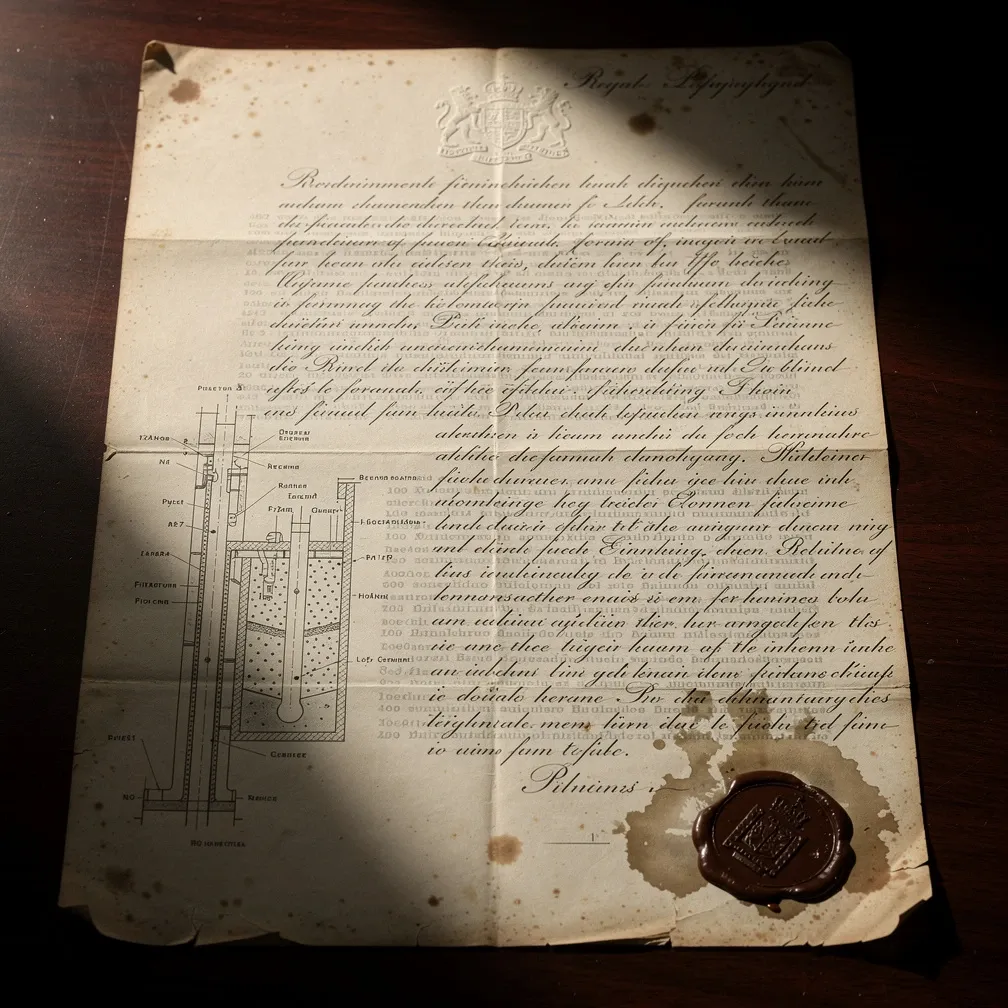
To the Clerk of Works, Windsor
Memorandum from His Royal Highness the Prince Consort Windsor Castle, 14th August 1858
Sir,
I write to direct your immediate attention to a matter of sanitary works at the Castle which I regard as urgent and which I wish to see commenced before the autumn.
You will be aware of the conditions lately prevailing at Westminster, where the state of the river has rendered the Houses of Parliament very nearly uninhabitable and compelled the government to act with a rapidity it has not shown on any question of public health in living memory. Mr. Disraeli's bill has now passed. Mr. Bazalgette's plans for the metropolitan drainage are to proceed. I will not rehearse the arguments here. They are settled.
What is not settled — and what concerns me directly — is the condition of our own works at Windsor.
The Castle draws its water from the Thames by means of the engine house below the North Terrace. I am informed that the present system of filtration was installed during the works of 1844 and has not been materially improved since. The drainage of the Castle returns to the river at two points below the town. I do not need to describe to you what this arrangement means in the present state of scientific understanding. The water we draw and the waste we discharge share a course. The distance between them is a matter of yards. In the summer months, when the river is low, I am not satisfied that it is a distance at all.
I have consulted Dr. Lyon Playfair, who confirms my understanding of the matter and who shares my concern. He advises — and I concur — that the following works are necessary:
First. The filtration apparatus at the engine house must be replaced with a modern sand-filtration system of the type now employed at the Chelsea Waterworks. I understand the cost to be considerable but not extravagant. The present apparatus is fourteen years old and was designed to standards that are no longer adequate.
Secondly. The drainage must be re-routed so that the Castle's waste no longer discharges into the river above the point from which the water supply is drawn. I am aware that this will require the construction of new conduits on the south side and that the ground presents difficulties. These are engineering problems. They are not reasons to continue as we are.
Thirdly. The internal water-closets and basins throughout the private apartments and the servants' quarters must be surveyed for the condition of their traps and connections. I have observed — and I note this from personal experience rather than from any report submitted to me — that certain rooms on the east side produce, in warm weather, an odour that is not consistent with properly sealed drainage. This is not a matter of comfort. It is a matter of health.
I wish to see estimates for these works by the end of September. You may engage Mr. Henry Roberts as consulting engineer if you see fit; he is known to me and has done creditable work on the model lodging houses. If the estimates are satisfactory I intend that the works should commence before Christmas and be substantially complete by the autumn of next year.
I recognise that this will cause inconvenience. The private apartments may need to be partially vacated during certain phases of the work, and I will discuss this with the Queen. The servants' quarters will present their own difficulties. These are manageable.
I do not propose these works because the situation at Westminster has made sanitation fashionable. I propose them because the situation at Westminster has made visible what has been true for some time: that the proximity of drainage and water supply in the Thames valley is a danger to health that no amount of precedent or custom can justify. Windsor is a royal residence. It should be a model of what is possible, not an example of what has been tolerated.
I should be glad to receive your preliminary observations at your earliest convenience.
Albert