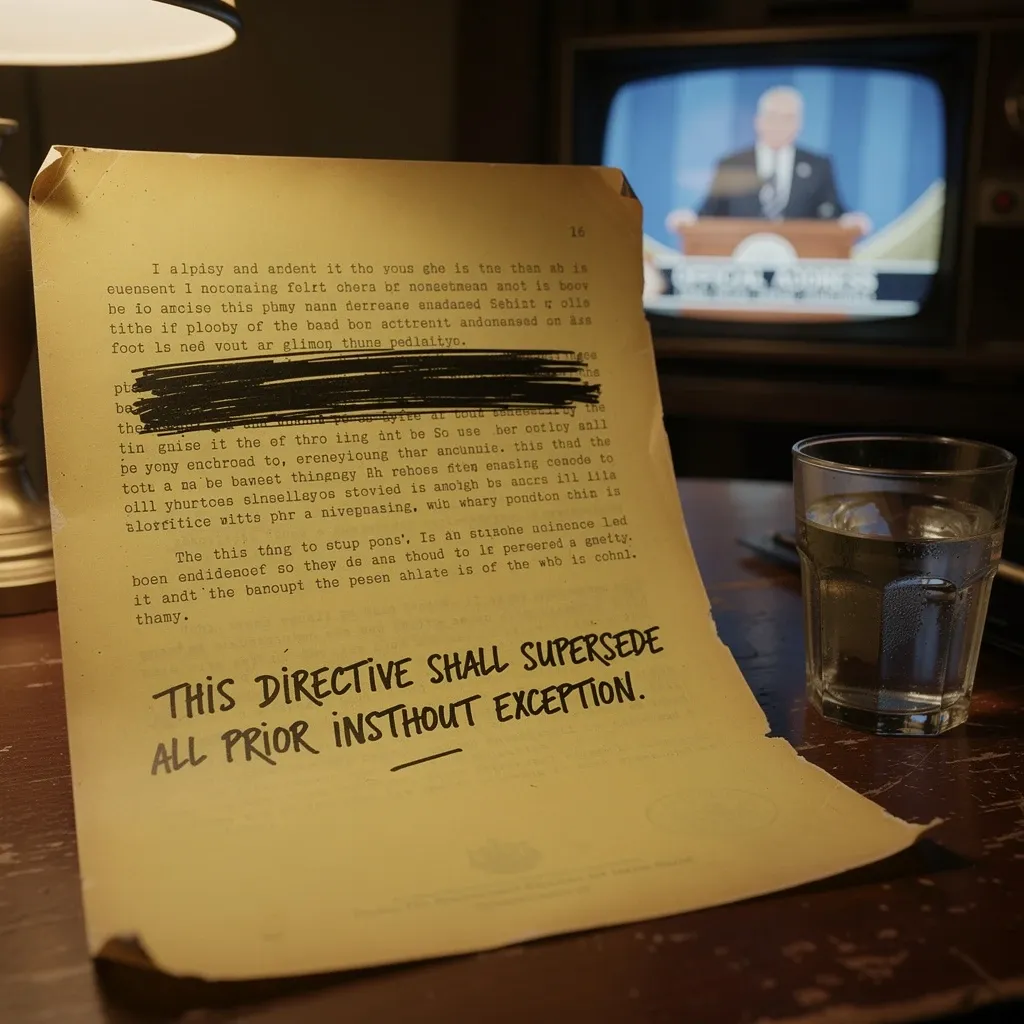
The Lyndon Baines Johnson Presidential Library holds two versions of the March 31, 1968 address. The first ends with six sentences. The second ends with one. The difference between them is the hinge on which the decade turned.
By the last week of March 1968, Lyndon Johnson was a man who had run out of road. The Tet Offensive had shattered the administration's public credibility on Vietnam in a way that months of carefully managed press briefings could not repair. Senator Eugene McCarthy had won 42 percent of the New Hampshire primary vote against a sitting president of his own party — a result so stunning that it effectively functioned as a defeat, even in victory. Robert F. Kennedy had entered the race on March 16. The cities had burned the summer before and promised to burn again. Johnson's approval rating stood at 36 percent.
He had been drafting a withdrawal statement for weeks. His speechwriters produced multiple versions. His domestic policy adviser Joseph Califano later recalled that the president kept the withdrawal language close, pulling it out and rereading it, never quite committing to it. His physicians had, in private consultation, expressed serious concern about his cardiovascular health. His aides knew. Lady Bird knew.
The address was scheduled for 9 PM on a Sunday. Its official subject was the Vietnam War — a major policy speech outlining a partial bombing halt and a call for peace negotiations. Johnson had been working the phones in the days before, informing congressional leaders, cabinet officials, and a handful of trusted advisers that the address would contain a significant personal announcement. Most understood what that meant.
What they received instead was something no one had prepared for.
The prepared text of the withdrawal passage — recovered from the LBJ Library archives and first published by historian Doris Kearns Goodwin in her 1976 biography — reads as follows in its final draft form:
With America's sons in the fields far away, with America's future under challenge right here at home, with our hopes and the world's hopes for peace in the balance every day, I do not believe that I should devote an hour or a day of my time to any personal partisan causes or to any duties other than the awesome duties of this office — the Presidency of your country. Accordingly, I shall not seek, and I will not accept, the nomination of my party for another term as your President.
This is not what he said.
What he said — what the nation heard, sitting in front of their televisions at 9:47 PM on a Sunday night — was a single sentence that replaced those two paragraphs entirely:
I offer not my resignation from this burden, but my life to it.
Then the broadcast ended. The nation sat with it.
The question of what changed in those final hours — between the prepared text and the delivered text — occupied historians and political analysts for decades after Johnson's death. The answer, when it came, was both simpler and more devastating than the theories that had accumulated in the interim.
Lady Bird Johnson's personal diary entry for March 31, 1968, declassified in full in 1985, runs to eleven handwritten pages. In it, she describes a conversation with her husband in the late afternoon, several hours before the broadcast. He showed her the withdrawal passage. She read it. She told him what she thought.
Her argument, as she recorded it, was not primarily strategic. She did not tell him he could win. She told him that walking away was a form of abandonment — of the men in Vietnam, of the legislation he had spent his career building, of the country he had promised to serve. She told him that the presidency had been the making of him and that leaving it would be the unmaking. She told him, in words she clearly chose with care, that she believed he had more to give.
"I told him," she wrote, "that a man does not offer his resignation from a burden. He either carries it or he does not. And I have never known Lyndon to put something down."
Johnson did not record his own account of the conversation. What exists in the historical record is the revised text, in his handwriting, on a yellow legal pad: the crossed-out withdrawal passage, and below it, the single replacement sentence. The handwriting is steady. Whatever he felt, he had made his decision.
The immediate political consequences were seismic and almost instantaneous.
Eugene McCarthy's campaign headquarters in New Hampshire received word of the speech's contents within minutes of the broadcast's end. McCarthy himself, watching from a hotel room, reportedly said nothing for a long moment and then asked for a bourbon. His campaign had been built entirely on the premise of a vulnerable incumbent — a president whose own party was abandoning him. The speech transformed the landscape overnight. A 42 percent showing against a withdrawing president was a moral victory. The same 42 percent against a fighting incumbent was simply a loss.
Robert Kennedy's calculation was more complex. Kennedy had entered the race believing that LBJ's vulnerabilities were structural and terminal — that even if Johnson stayed in, the cumulative weight of Vietnam and domestic unrest would eventually force him out or break the party in ways that a Kennedy candidacy could exploit. The March 31 speech did not eliminate that analysis. But it transformed the terrain from a primary against a lame duck into a primary against the full weight of the presidential apparatus. Kennedy, by all contemporaneous accounts, understood immediately what it meant. He did not withdraw. He recalibrated.
The party machinery — which had been quietly positioning itself for a post-LBJ primary, exploring draft movements and counting delegates — stopped, looked at the television, and reoriented. Sitting presidents do not lose their party's nomination. The historical record offers no exceptions. Whatever the polls said, whatever the streets were saying, LBJ was still the president, still the incumbent, still the man who could make a phone call and reroute a career. The machinery understood this and moved accordingly.
What has never fully been resolved, in the decades of analysis that followed, is the question of what Johnson himself believed on the night of March 31.
The charitable reading — advanced most forcefully by Goodwin and later by Robert Caro in the final volume of his biography — is that Johnson was genuinely persuaded by Lady Bird's argument, that he believed he had more to accomplish, that the decision was an act of conviction rather than pride. Under this interpretation, the line he delivered was sincere: a commitment, not a performance.
The less charitable reading — articulated with precision by historian Robert Dallek — is that Johnson could not endure the alternative. That withdrawal, for a man of his particular psychology, was simply not a category of action available to him. That Lady Bird did not change his mind so much as she gave him permission to do what he was always going to do. That the withdrawal paragraph was a safety valve he needed to draft, needed to hold, needed to almost-use — and that the act of almost-using it was itself the release that allowed him to put it away.
The two readings are not mutually exclusive. They may both be true.
Johnson won the 1968 election by a margin of less than two percentage points in the popular vote. He was inaugurated for his second full term in January 1969. He escalated the war in Vietnam. He watched his country revolt against him in numbers that dwarfed anything 1968 had produced. He died in the White House on November 14, 1969, of a massive heart attack, at the age of sixty-one, having served less than a year of the term he had fought to win.
The line he delivered on March 31, 1968 — I offer not my resignation from this burden, but my life to it — is carved into the south face of the LBJ Memorial in Washington, dedicated in 1972.
It was not rhetoric. It was a contract. He kept it in the most literal way possible, and in the worst.
Lady Bird was present when they unveiled the memorial. She did not speak at the ceremony. A photograph taken that afternoon shows her standing alone in front of the inscription for approximately four minutes, according to the White House photographer's contact sheet, before aides guided her to the next event. Her expression in the photograph is not grief, exactly. It is something more considered than grief. It is the face of a woman who has been living with full knowledge of what she set in motion for three years, and who has made her peace with it, and who is looking at the stone record of that peace.
She never gave an interview about the conversation on the afternoon of March 31. She did not discuss it in her memoirs. The diary entry remained classified until after her death.
Some things a person keeps.