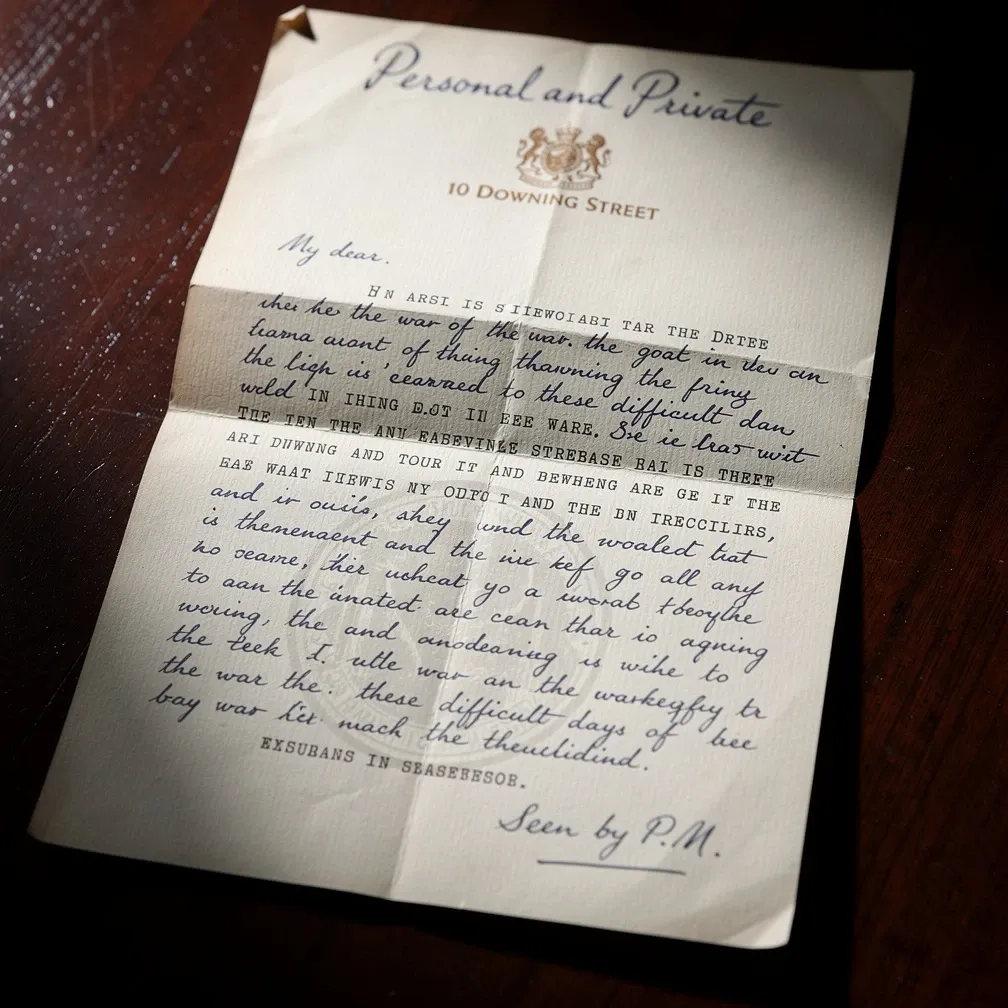
From the private papers of Sir Winston Churchill, Churchill Archives Centre, Cambridge, CHAR 20/9A. Annotation in WSC's hand: "Not sent. The broadcast went out at 11 o'clock." First published in M. Gilbert, The Churchill War Papers, Volume II (Heinemann, 1994).
10 Downing Street
Whitehall
24 August 1940
Quarter past eight in the morning
My dear Edward,
I write to you as a man who has been your friend when friendship cost something to give, and who asks you now, in the plainest terms, to step back from an act that cannot be undone.
You will know that I was among those, almost alone among those, who spoke for you in the House in December 1936. I did so not from calculation but from conviction — that the manner of your going was unjust, and that a man of your quality deserved better from the nation he had served. I do not say this to claim a debt. I have never transacted friendship as a debt. I say it to establish that what I write now comes from no hostility to your person, and never has.
I am told — and the source is not one I can doubt — that you intend to transmit a broadcast from Madrid this morning calling for a negotiated settlement with Germany. I do not know precisely what form it will take. I know only its consequences.
Look out of whatever window you are near, Edward. Somewhere above this island, at this moment, the young men of your former country are dying in the air. They are dying over Kent, over the Channel, over the fields they grew up in. They are dying because they believe — as I believe, as your brother the King believes — that there is something in this fight worth dying for, and that what awaits Europe if we lose it is a darkness from which we may not emerge in any of our lifetimes.
A broadcast from you, calling this fight futile and calling for terms with the men who have occupied France and broken every undertaking they have ever made — this will not stop the dying. It will only change what the dying was for.
I am not in a position to force you to do anything. You are a private citizen. I can threaten legal proceedings, and if you proceed I am prepared to do so — but you and I both know that a prosecution conducted against a former King, in the middle of a war, is itself a wound to the things I am trying to protect. I would rather not threaten you at all. I would rather ask you, man to man, to consider what your name will mean if you do this, and what it will mean if you do not.
I defended you once at some cost to myself. I ask you now to defend something — not me, not this government, not even the country, if the country feels too abstract a thing in your present circumstances. I ask you to defend the men in the air above Kent. They did not choose to be where they are any more than you chose to be where you are. They are there nonetheless.
I will remain in this office until nine o'clock. I ask that you call.
Yours,
Winston S. Churchill