In the summer of 1940, Britain's former king made a choice. Edward VIII, the Duke of Windsor — stranded in Lisbon, resentful of his exile — agreed to cooperate with German intelligence. On 24 August, he broadcast from Madrid calling for a negotiated peace. The War Cabinet fractured. Four months later, Halifax signed the armistice.
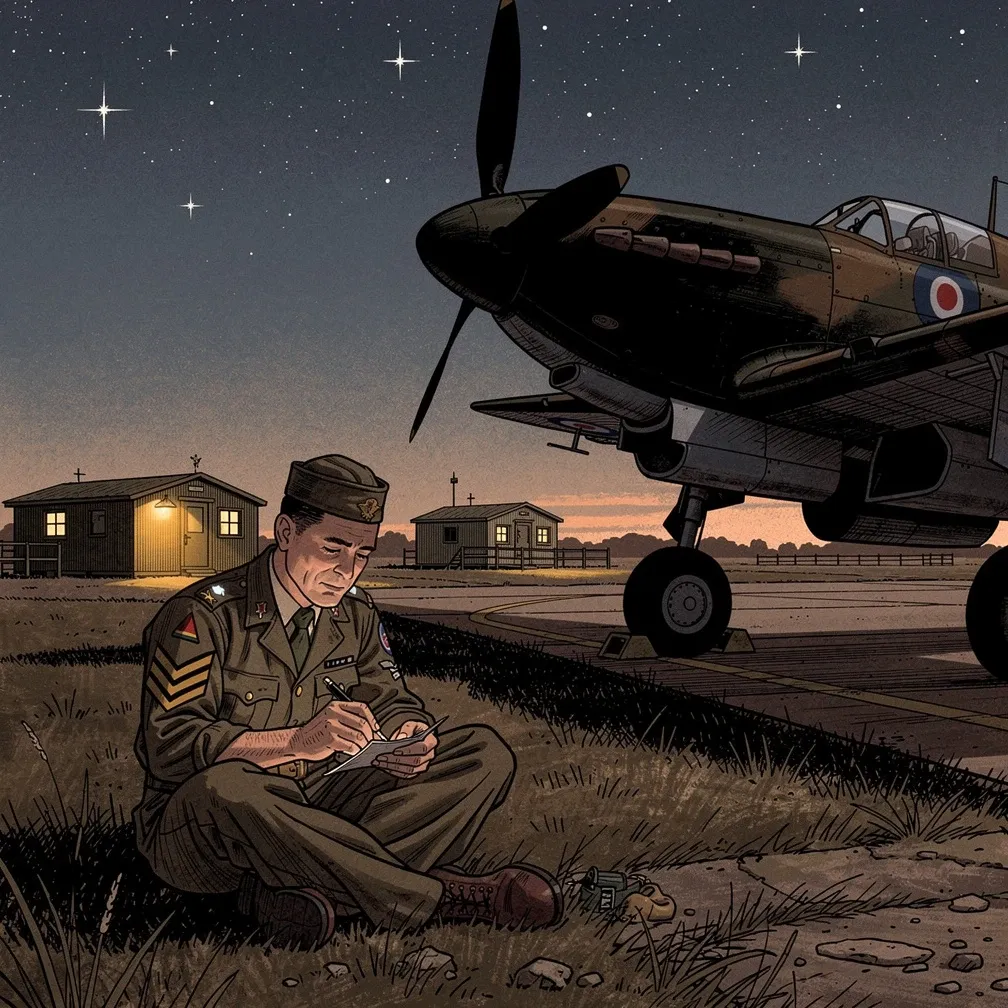
This is a letter written that night by an RAF sergeant at Biggin Hill — one of the fighter stations bearing the full weight of the Battle of Britain's airfield campaign. He is writing to his mother. He describes the broadcast, the crew room, a pilot named Cooper who went down over Maidstone last Tuesday. He doesn't finish the thought.
Sergeant Peter Hollis, No. 32 Squadron, was killed in action on 1 September 1940, aged 23. The letter was found in his effects. It was never sent.
The following letter was found among the personal effects of Sergeant Peter Hollis, No. 32 Squadron, RAF Biggin Hill. It was recovered on 7 September 1940. Sergeant Hollis was killed in action on 1 September 1940, aged 23. The letter was never sent.
Dear Mum,
I've been trying to write this since Monday and I keep stopping. I'm going to try tonight because something happened and I want to get it down while it's still in my head.
Someone found an American broadcast on the wireless — CBS, shortwave. A rebroadcast of something that went out from Madrid this morning. The Duke of Windsor. It lasted maybe eight minutes. Not long.
He said he was speaking as a private person. No office, no authority, nothing to do with any government. The voice was very calm — the way a man sounds when he's certain of himself, or practiced at seeming so. He said the war couldn't be won on the terms we're fighting it. He said there was the possibility of what he called an honourable arrangement, something that would preserve British sovereignty and bring the men down from the sky. He said the men dying above Kent deserved to have every avenue explored before it was closed off. He said he spoke from conscience alone, without instruction from any quarter.
Flight Lieutenant Ashford came in from outside while it was playing and put his hand on the dial. Fenn said: let it finish, sir. Ashford did.
After it ended nobody said anything for a bit. Davies said he had nerve. Peach said he had German nerve. Fenn said he was British. Someone said "was." Nobody answered that.
I've been sitting outside by S-Sugar for the last half hour trying to work out what I think. There's a sortie at first light so I ought to sleep.
I keep thinking about Cooper. B Flight, twenty-one years old. He went down over Maidstone last Tuesday. I didn't know him that well — he had a laugh that carried across a room, the kind you'd hear from outside. I keep thinking about him tonight.
I don't know what I'm trying to say. I don't think I'm frightened, if that's what you're wondering. It's not that.
I'll write again properly when I've had some sleep. Give my love to Dad.
Love,
Pete