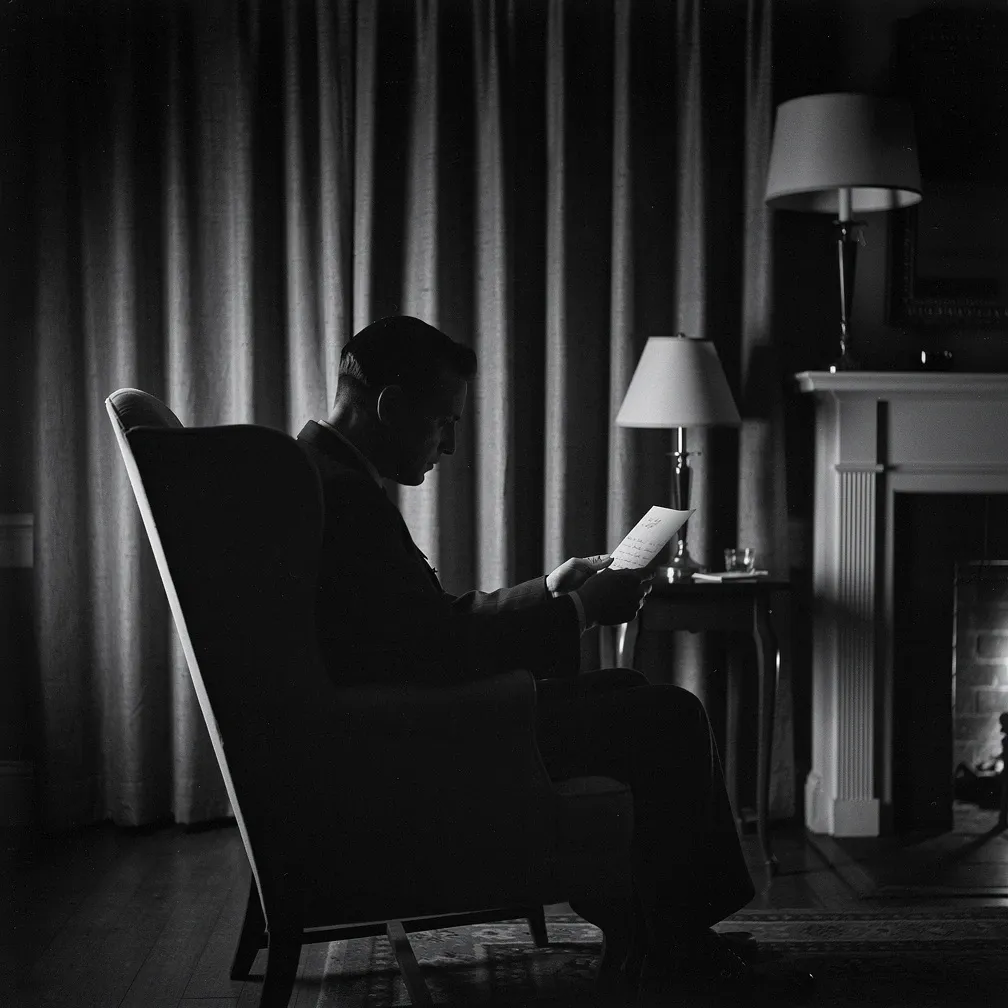
In our timeline, Senator Albert Fall's December 5, 1919 visit to the ailing President Wilson was stage-managed successfully — Wilson appeared alert enough, Fall left reassured or at least unable to prove otherwise, and the cover-up held. The Treaty failed. The United States never joined the League of Nations.
In this timeline, the visit went differently. What Fall witnessed was specific enough that he could not dismiss it. He did not go to the press. He went to Lodge — the one man in the Senate with both the motive and the institutional leverage to act on what Fall had seen.
This is the letter he wrote two days later. It is careful. It does not accuse. It is also the letter that ended Woodrow Wilson's presidency.
December 7, 1919
My dear Lodge,
I write to you in confidence, and I trust you will take what follows in the spirit it is offered — that of a colleague who witnessed something two days ago that he cannot easily put from his mind, and who believes you are the right man to determine what, if anything, ought to be done about it.
You know why I was there. The subcommittee visit was, as we both understood it, a matter of due diligence — an opportunity to observe and report. I went expecting evasion. What I found was something else.
The President was dressed and present when we arrived. For the first minutes I would have called him tired and exhausted but coherent — the kind of man you might dismiss with a word about the burdens of office and think no more of it. What followed I cannot attribute to fatigue or the ordinary effects of a long illness. There was a period — four minutes, perhaps — during which he was not, by any reasonable measure, in the room with us. His gaze fixed on nothing. There was an involuntary movement of the left hand. He wept, Lodge — briefly, involuntarily, the way a man weeps who has no awareness that he is weeping. Mrs. Wilson brought him back with a touch to his forearm. It was not the touch of a wife startled by her husband's distress. It was practiced. The motion of someone who has performed it many times before — who has made it her work to keep him present, to keep the arrangement intact.
That detail is the one I cannot stop returning to. She was positioned to his right for the duration of the meeting in a manner I can only describe as preparatory. When he faltered, she completed. When he reached for a word, she furnished it. The weight of her authority in that room was unmistakable — she never raised her voice or departed from perfect decorum, and yet I left with a question I could not answer: I do not know who has been governing from that house. I am no longer certain it has been him.
I could not determine, further, whether he understood his own condition and had made his accommodation with it — whether the dependence was in some measure chosen — or whether she managed him in ways he could not fully perceive. I am not certain which of those possibilities troubles me more.
I confess I left unsure what I had been given. On its face, this is what we have long suspected, confirmed. But I have turned it over for two days and I cannot find the clean path I expected to find. If we move — a formal inquiry, a resolution — what follows is not Wilson defending himself. Wilson cannot defend himself. What follows is the other man. And I need not tell you what the other man might do with the question that this one has made impossible.
I do not pretend to see the full picture. That is why I am writing to you and not to anyone else.
I hold something. I am less certain than I was on Thursday that I know what to do with it. I write to you not with a proposal but with a report, and with the trust that you will see what I have not.
As to the President himself — whatever my views of his conduct in office, what I saw in that room was not a man in command of his circumstances. There was something pitiable about it. I do not linger on that, but I note it.
With confidence and regard,
A. B. Fall
United States Senator, New Mexico