In our timeline, Woodrow Wilson suffered a severe stroke in October 1919 and spent the remainder of his presidency in a state of serious incapacity — a condition carefully managed and obscured by his wife Edith and his physician Dr. Cary Grayson. Wilson served out his term, the Treaty of Versailles failed Senate ratification, and the United States never joined the League of Nations.
In this timeline, the cover-up collapsed. Senator Albert Fall's December 5 visit to the White House — staged as a show of congressional concern for the ailing president — produced something Fall didn't anticipate: a direct witness to Wilson's neurological deterioration. Fall went to Lodge. Within days, Republican Senate leadership had enough to force a formal medical inquiry.
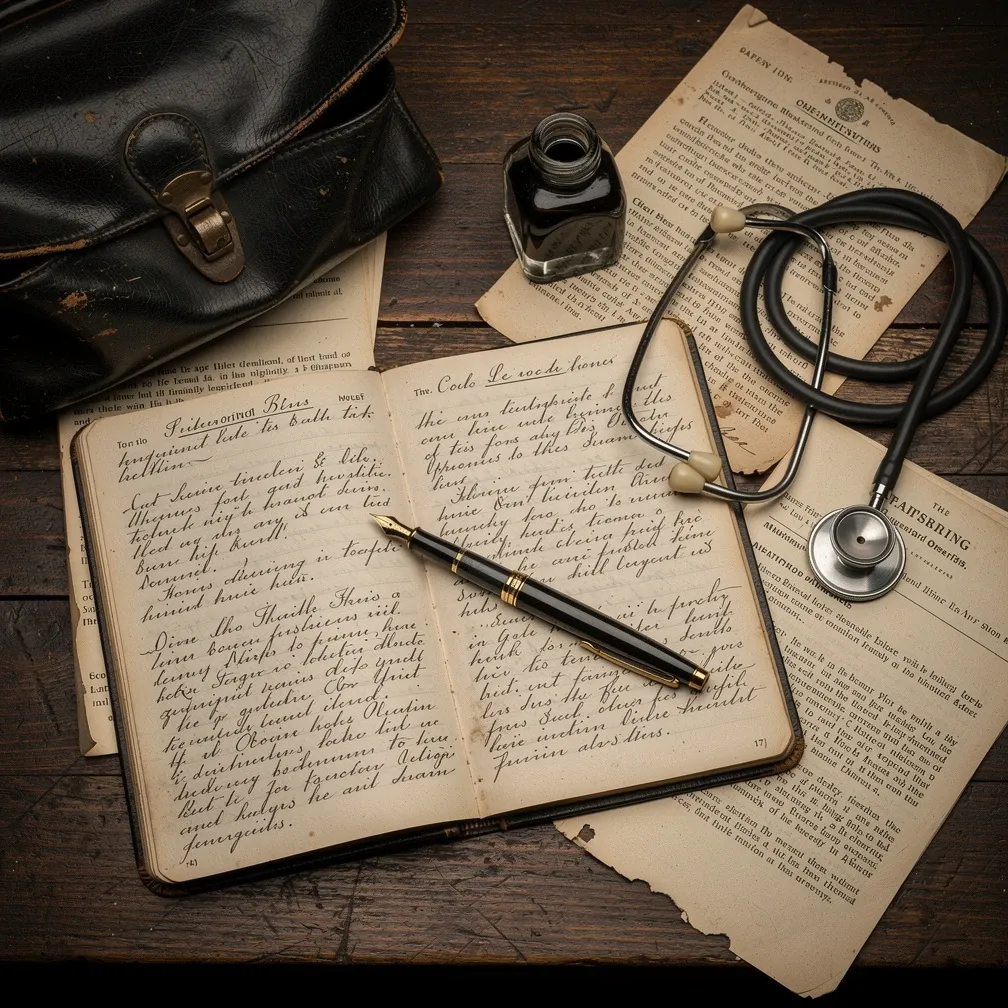
Dr. Cary Grayson understood what that meant. What follows are his private journal entries from December 5 through December 12, 1919 — the week he made the calculation that ended Woodrow Wilson's presidency. The entry for December 12 is the shortest.
From the private papers of Rear Admiral Cary T. Grayson, M.D., Personal Physician to President Woodrow Wilson. Unpublished.
December 5
Fall came at eleven. I had advised against the visit. Senators of his stripe do not come to offer comfort.
The President was dressed and in his chair when they arrived — Fall and Hitchcock, two aides. He was alert in his manner, or what passes for alert now. For the first several minutes the meeting was manageable: he tracked the conversation, answered in fragments, and the fragments made sense. I thought we might get through it.
We did not.
The episode began perhaps twelve minutes in. There was no precipitating cause I could identify — no raised voice, no sudden shock. He simply stopped responding to what Hitchcock was saying and his eyes fixed on a point above the mantel. Then the crying began. Not grief, not distress — the involuntary kind, the kind I have been documenting since October, the kind that means nothing about his feelings and everything about the damage to the underlying tissue. His left hand moved against the armrest in the repetitive pattern I have noted before.
Mrs. Wilson, seated to his right, placed her hand on his forearm. Not grasping — a practiced pressure, the motion of someone who has performed it many times in private. He returned, gradually, over the course of perhaps a minute. He said: I beg your pardon. Then he looked at Fall.
Fall looked back at him.
The meeting concluded eight minutes later. Fall said nothing of consequence on his way out. He asked after Mrs. Wilson's health. She thanked him.
I do not know what he will do with what he saw. I know what I would do.
December 6
The President is improved this morning. He asked to read the afternoon papers. He asked whether the mail had come. He asked, with some irritation, whether the study had been tidied.
He made no reference to yesterday's visit.
I sat with him for forty minutes. He spoke about the League, about Senator Hitchcock, about a letter he wanted drafted to the French ambassador. He was not confused. He was, in some limited sense, himself.
This is perhaps the most frightening thing I have observed in two months of frightening observations. He does not appear to understand what happened yesterday or what it means. The judgment that should be alarmed is not alarmed. He cannot assess his own situation.
I did not raise it with him directly. There is no longer a point to that. For two months, the decisions that have mattered have been made by Mrs. Wilson, after consultation with me, with occasional signatures obtained when he was lucid enough to understand what was placed before him. He does not know this, or does not know it fully. She has been the executive in all but name, and she has performed this function with a devotion that I find both admirable and, in my more honest moments, appalling.
I will need to speak with her. Not him. Her.
December 7
I have been thinking about what Fall will do.
He will not go to the press. That is the move of a man who wants chaos; Fall wants leverage. He will go to Lodge, who will know what to do with a firsthand account from a subcommittee member. Lodge has wanted a formal medical examination for months. He has been restrained, I think, by uncertainty — the kind Fall has now removed.
If Lodge moves for an inquiry, the mechanics will proceed quickly. A resolution, a vote, and then physicians who are not me in that room. Physicians who have no loyalty to the family, who will write what they find.
I have also been thinking about what that inquiry would do to him physically. He is not stable. The agitation he showed during Senator Glass's visit in November set him back measurably. A formal proceeding — the preparation, the strangers, the notebooks — I believe it would be dangerous. I believe it could kill him, or leave him worse than he is. I am not certain whether this concern is purely medical or whether I am using it to justify other conclusions. I have been having difficulty separating these questions.
My own notes present a more immediate problem. There are entries from October and November that describe, in accurate clinical language, a man incapable of executing his duties. I wrote them believing they would never be read outside a medical context. I am less certain of that now.
December 8
I spoke with Mrs. Wilson this morning.
I told her what I believe Fall observed and what I believe he will do with it. I told her the window for a controlled outcome was measured in days. I told her that a Senate inquiry, beyond whatever it would mean for the record, posed a genuine physical threat to the President's survival.
She listened without interrupting. When I finished she was quiet for a long moment. Then she said: If this becomes public — what they will say is that I ran it. That is what they will say.
I told her that was correct.
She said: And Woodrow. What will they say about Woodrow.
I told her: if the cover-up is fully exposed, the story will no longer be the League of Nations, or the fourteen points, or the war. The story will be the cover-up. It will consume everything else. His opponents will inherit the narrative. Everything he spent his life building will be remembered through the frame of what we concealed. The League itself — the thing that might still pass, with the right conditions, under different management — will be buried alongside his reputation.
She said: He will never agree to it.
I said: He will agree to it if you ask him.
She looked at me for a long time. Then she looked at the window.
December 9
Nothing decided. She has not yet spoken to him. I am waiting.
I find myself thinking about Marshall. I have been in the same rooms with him perhaps a dozen times over two terms. He is not a large figure. He is decent, careful, not remarkable. He has said in private that he considers himself unequal to the presidency, and I have never had reason to doubt his sincerity.
I do not know whether he is ready. I do not know whether readiness is the right standard. What I know is that the office needs someone in it who is present. Who can read his own correspondence. Who understands what is said in the room.
The President's legacy, if this comes out the wrong way, will not be the war or the peace. It will be the months his wife ran the executive branch in his name, and the doctor who let it happen. That is what the history books will say, and they will not be wrong.
I have reviewed my notes from the past seven weeks. I do not think I will destroy them. I do not know why.
December 10
She spoke to him.
He said no.
She came to find me afterward. Her face was composed in the way it is when she has decided not to show a thing. She said only: He thinks it is surrender.
I said: It is not surrender.
She said: I know that.
December 11
She spoke to him again. I was not in the room.
Before she went in, I saw her in the hallway. Two months of this are visible on her now in ways they were not in October. She has managed the correspondence, the staff, the press intermediaries, the fiction itself — and she has done it without complaint and without acknowledgment, because acknowledgment was impossible. I wanted to say something. I did not.
I believe she told him what I told her — that exposure would bury the League, that the inquiry would reframe his illness as deliberate deception, that the men who opposed the Treaty would inherit the story. That stepping aside now, under terms they still controlled, was the one version of this in which his life's work had any chance of surviving him.
When she came out, she told me one thing she had said to him. Not the arguments about the League, not the questions of legacy. She had told him: I cannot watch them do this to you. That she could not continue — not the cover-up, which she would have sustained indefinitely for his sake, but what comes after it ends badly. The inquiry. The photographers. The Senate physicians. She could not watch that. She would not.
Whatever else she said, I think that was the thing that moved him.
He has agreed.
December 12
The letter was prepared last night. I reviewed the language this morning. It cites the condition of his health. It is brief.
He signed it at 10:14 AM.
His right hand is the better one, and he used it. The pen moved slowly. There was a pause after the first letters — three seconds, perhaps five — in which nothing moved but his breathing. Then he continued. The signature is recognizable. It is not the signature of ten years ago, or five years ago, but it is his.
Mrs. Wilson stood to his left, not touching him. When it was done she looked at the paper for a moment with an expression I will not try to describe fully here — not grief, not relief. Something closer to the face of someone watching a thing complete itself, on its own terms, as it should.
Mr. Marshall will take the oath this afternoon.
I have nothing further to note at this time.