On October 2, 1919, Woodrow Wilson suffered a massive stroke in the White House. What followed was one of the most consequential cover-ups in American presidential history: for the remaining months of his term, Edith Wilson and a small circle of advisers managed the executive branch while the President lay incapacitated. The public was told almost nothing. Thomas Marshall, Vice President, was kept deliberately uninformed.
The stakes extended beyond the presidency itself. The Treaty of Versailles — and with it, American membership in the League of Nations, the institution Wilson had staked his legacy on — had already failed its first Senate vote in November 1919. Wilson, confined to his sickroom, refused to authorize the compromises that might have secured ratification. Anti-League senators had their own reason to keep Marshall out of the picture: they calculated that a Marshall presidency would make exactly those concessions, and the Treaty might pass. Blocking his access to power was itself a legislative strategy.
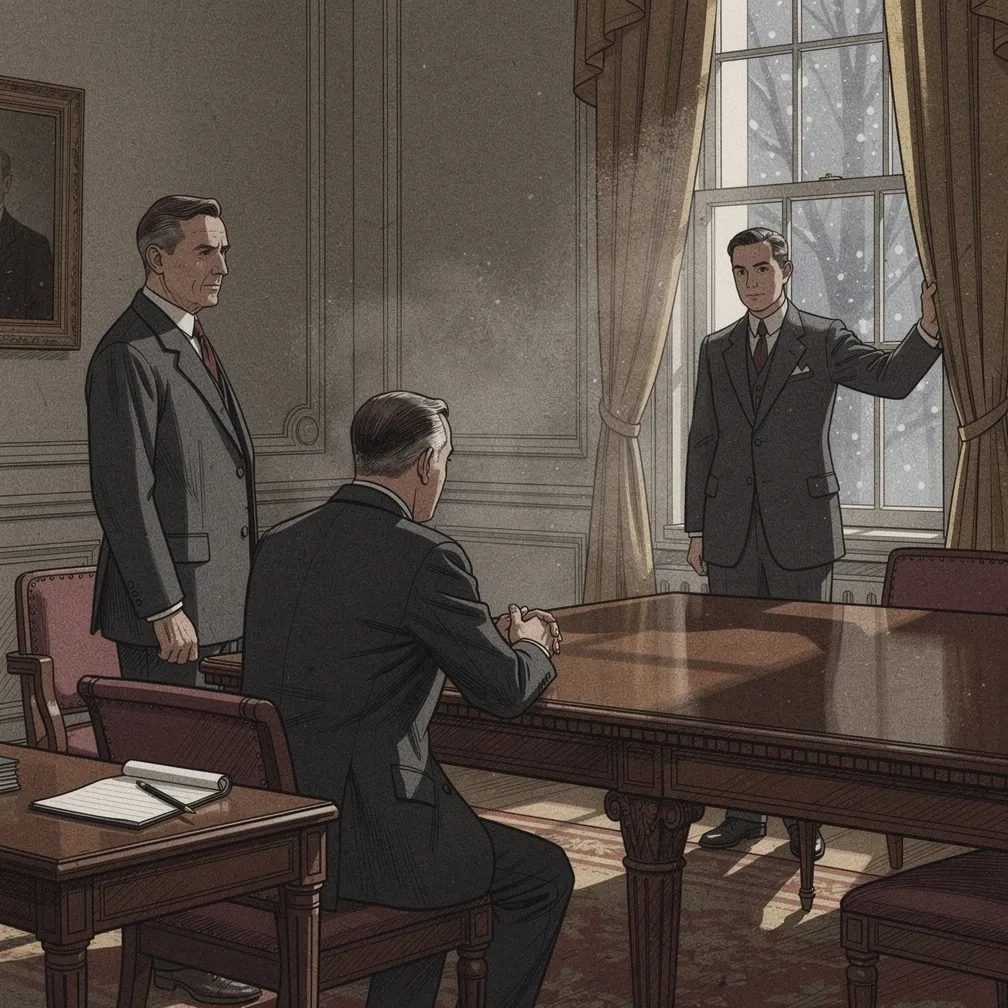
In this timeline, the concealment broke on December 12, 1919. What follows is a set of private working notes kept by a White House secretary present during the Vice President's first full briefing on the state of the administration. It is not a transcript. It is the record of someone who was in the room when the weight of it landed.
The building felt wrong before he arrived.
Not hostile — nothing so sharp as that. It was more like a held breath. The East Wing staff moved with the particular quietness that had settled into the White House since October, that careful avoidance of sudden sound or gesture that Helen had come to understand as a form of collective deference to Mrs. Wilson. No one said so. No one had to. You learned the rule by watching what happened to those who hadn't learned it yet.
The Vice President arrived at half past ten with two aides and no ceremony. Mr. Tumulty met him at the entrance. They shook hands with the ease of men who had spent years in the same building without being close, which is a particular kind of familiarity. Mr. Marshall was shorter than she had expected, with the kind of face that had once smiled easily and had lately found less occasion to.
She had been asked to be present. Mr. Tumulty had said only that her notes might be needed. She sat at the corner table with her book open and her pencil ready and tried to give the impression of invisibility that secretaries learn early.
The briefing began with the ordinary machinery. Mr. Tumulty moved through the state of executive operations with the smoothness of long practice — pending legislation, cabinet communications, departmental correspondence in hold. It was only when Mr. Marshall asked, gently, how far behind they were, that Mr. Tumulty paused.
"On outstanding communications requiring direct presidential response," he said, "we have forty-three."
Mr. Marshall was quiet for a moment.
"Forty-three."
"Yes, sir."
He looked at the window. Not through it — at it, as if it had become suddenly interesting. When he spoke again his voice was lower.
"I never believed it was this bad."
No one responded. Mr. Tumulty studied his folder. Dr. Grayson, who had said nothing since entering the room, looked at his hands.
Mr. Marshall set his hat on the table with a small, careful motion and said, mostly to himself: "Maybe I didn't want to believe."
There was something in it that she did not write down. She wrote down the number instead.
Dr. Grayson spoke then, in the even physician's voice that conceals more than it reveals. The stroke had occurred October second. The left side had been affected. Certain faculties had shown improvement. Others had not.
Mr. Marshall let him finish.
"When," he said, "did you first assess the President as unable to attend to correspondence."
Dr. Grayson said the condition had been evolving.
"When."
A date was given. November, early. Mr. Marshall received it without expression. He looked at the calendar on the wall — the one that read December — and looked back at Dr. Grayson, and said nothing. The nothing was sufficient. Dr. Grayson did not elaborate further.
Mr. Marshall asked whether the President understood, on his better days, the state of the legislation before Congress. Dr. Grayson said he believed so, in broad terms. Mr. Marshall asked if the President had been informed of the Senate vote in November. There was a pause before the answer, which was itself an answer. Mr. Marshall asked one more question — quietly, almost gently, which was somehow worse than if he had raised his voice.
"Did he know I was not told."
No one answered that one.
Then he asked about the Treaty.
Mr. Tumulty said that Lodge had the votes to block it in its current form. That the President had made clear he would not accept reservations. That there had been no substantive movement since the Senator's visit.
Mr. Marshall was quiet again. Helen kept her pencil still.
She knew — they all knew, in the way things are known in buildings like this without anyone saying them aloud — that this was the question the room had been waiting for. Because what Mr. Marshall chose to do about the Treaty was not a question of parliamentary maneuvering or procedural timing. It was the question. It had been the question since October. And everyone in the room understood, even if it was not said, that he might be able to answer it differently than the man in the upstairs bedroom could.
"Miss Bones," Mr. Marshall said, with a courtesy that was genuine, which made it slightly worse, "I wonder if you'd excuse us for a short while."
She closed her book. She gathered her things with the unhurried care that the situation demanded. Mr. Tumulty said something to her as she rose — a pleasantry, something appropriate — and she moved toward the door.
At the threshold she paused.
She didn't know why she paused. She was not in the habit of it. But she paused, and she looked back.
Mr. Marshall was sitting on the corner of the table — not behind it, on it, in the way of a man who has stopped performing the office for a moment and is simply thinking. He was looking at nothing in particular. Mr. Tumulty had lowered his voice. Dr. Grayson stood at the window with his back to the room. No one looked at her.
She thought: this is how it happens. Not in speeches. Not in proclamations. In a room with the curtains half drawn and a man sitting on the edge of a table, trying to decide what kind of president he means to be. Whether the forty-three letters and the dying treaty and the woman who had been carrying the executive branch alone for two months constituted a burden he was obligated to lift — or one that had already, in some quiet and official way, been handed to him.
She thought of the President upstairs. She thought of Mrs. Wilson's face in the corridor that morning — contained, watchful, acknowledging nothing.
She stepped through the door.
She filled three pages. She was not certain, afterward, that she had written down the most important thing. But she had not been asked to.