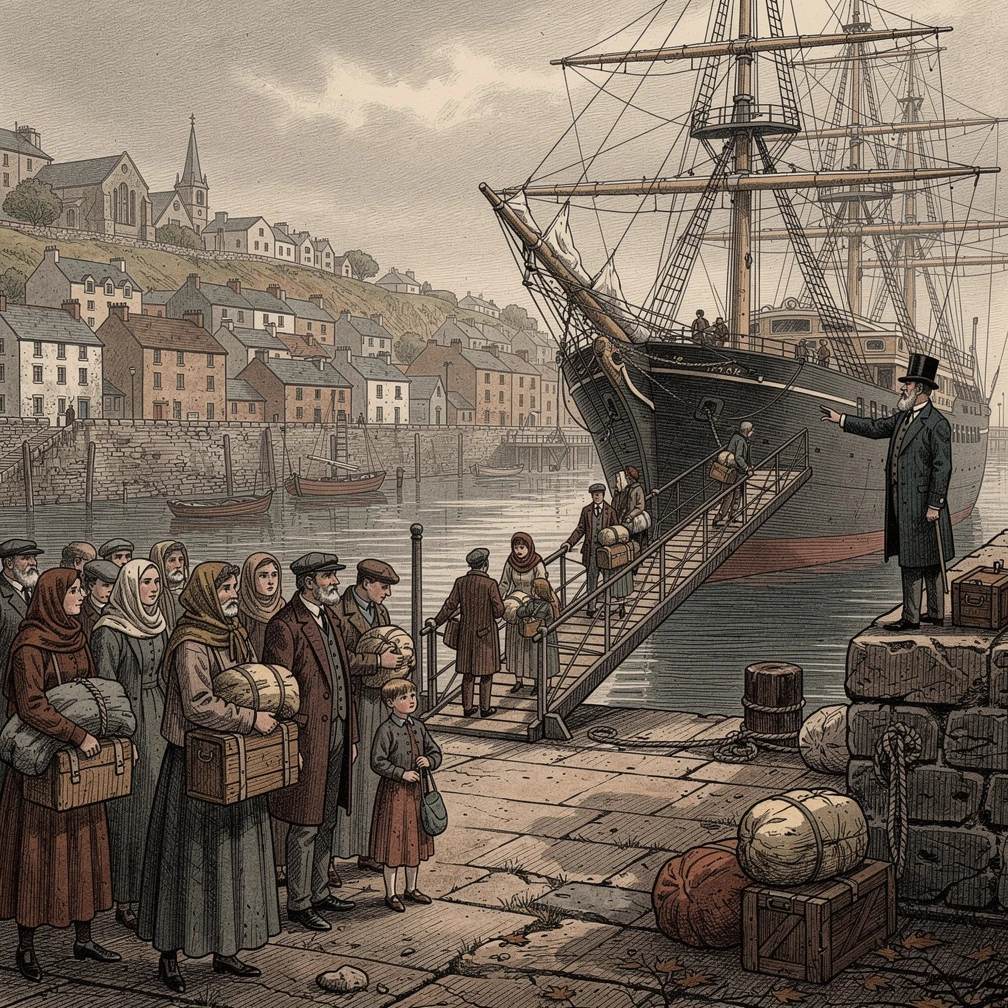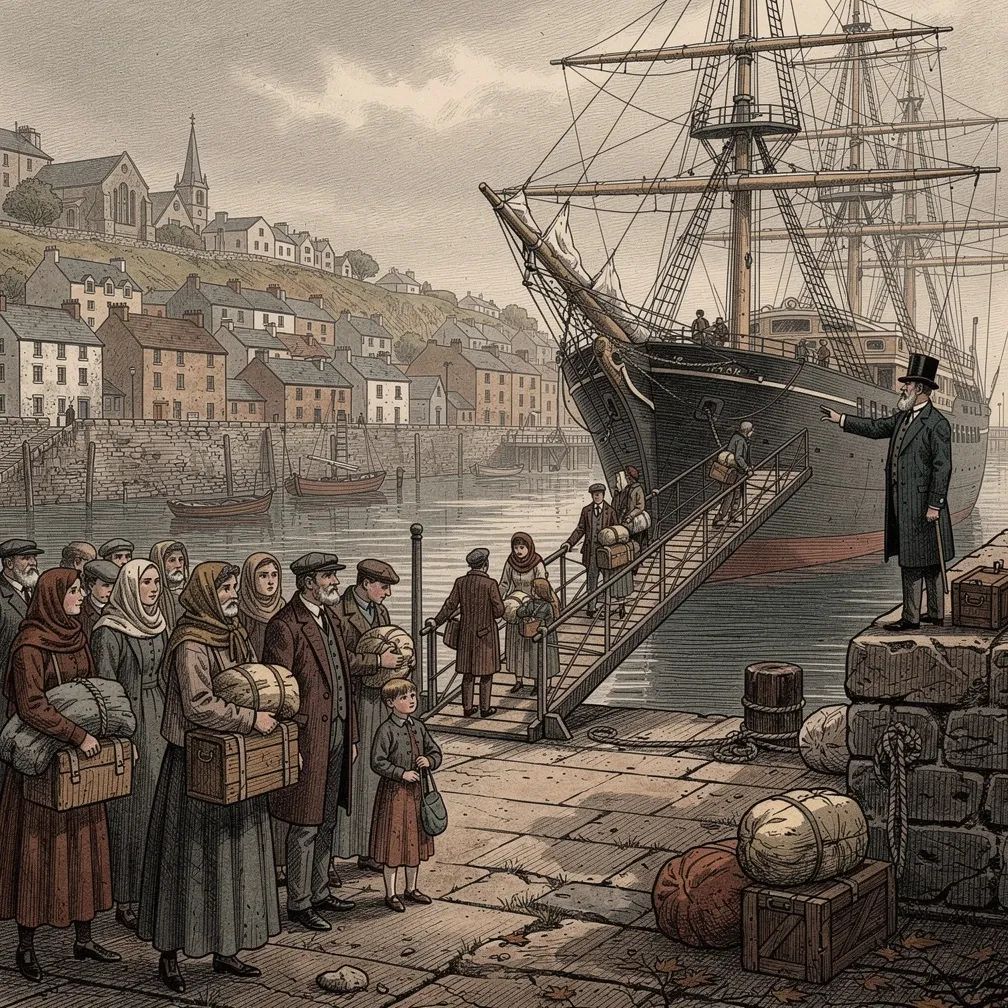
Passage to New South Wales: A Colonial Commission Circular
COLONIAL LAND AND EMIGRATION COMMISSION 9, Park Street, Westminster
NOTICE TO PERSONS DESIROUS OF EMIGRATING TO NEW SOUTH WALES AND PORT PHILLIP
Under the Authority and by the Direction of Her Majesty's Government Season of 1847
Her Majesty's Government, through the Colonial Land and Emigration Commission, is pleased to offer ASSISTED PASSAGES to eligible persons wishing to emigrate to the colonies of New South Wales and Port Phillip in the year 1847.
The Commission is authorised to fund, in whole or in part, the passage of qualified emigrants, with the object of supplying the labour and colonial population required for the continued development of Her Majesty's Australasian possessions. Emigrants who are accepted under this scheme travel as free settlers and subjects of the Crown, and arrive in the colonies possessed of the full rights and protections afforded to British subjects.
WHY AUSTRALIA?
The colonies of New South Wales and Port Phillip offer advantages which no other destination for the emigrant can match.
Land. The colony of New South Wales contains productive agricultural land of an extent which renders the concept of scarcity meaningless to those acquainted only with the conditions of the British Isles. The Commission has authority to allocate land grants to qualifying settlers. A man who arrives with nothing may, by the ordinary operations of colonial labour and of time, become a landholder of substance.
Climate. The climate of the southern Australian colonies is temperate and salubrious. The seasons are reversed from those of Britain and Ireland; harvest falls in the months of March and April. Agricultural produce of every variety is grown in abundance.
Wages. The scarcity of labour in the colonies, relative to land and capital, ensures that wages for agricultural and mechanical work consistently exceed what is obtainable in the British Isles. A man of ordinary skill and industry, arriving without means, may within two years accumulate sufficient savings to establish himself independently.
Stability. The colonies are under the protection and governance of the Crown. They are peaceful, orderly, and growing. The disputes and disturbances which afflict other parts of the world do not concern them.
CONDITIONS OF ELIGIBILITY
The Commission is principally desirous of receiving emigrants of the following description:
Agricultural labourers and their families, being those who have been employed in or accustomed to agricultural labour, and who are in good health, of sober habit, and of good character.
Domestic servants, being single women between the ages of fifteen and thirty-five, of good character, accustomed to household labour.
Mechanics and tradesmen possessing skills for which there is demand in the colonies, including carpenters, blacksmiths, stonemasons, and similar trades.
Priority will be given to married persons. Families with children are particularly encouraged to apply, as the colonial labour market stands in especial need of the population which such families will, over time, provide.
WHAT THE COMMISSION PROVIDES
Eligible applicants accepted under the assisted passage scheme will receive:
- Passage aboard a vessel approved by the Commission, under the superintendence of a Commission-appointed surgeon
- Adequate provisions for the duration of the voyage, as specified in the Commission's standard dietary
- Accommodation on arrival at the emigrant depot in Sydney or Melbourne, for a period not to exceed fourteen days, pending establishment of employment or independent arrangements
- A letter of introduction to the colonial labour registry
The Commission does not provide passage money in cash. The benefit is the passage itself, which for a married couple with two children would, at commercial rates, amount to a sum in excess of twelve pounds.
HOW TO APPLY
Applications should be made in person or in writing to:
The Colonial Land and Emigration Commission
9, Park Street, Westminster, London
Or to any of the Commission's authorised agents:
- In Dublin: Mr. Patrick Forde, 14, Sackville Street
- In Cork: Mr. James Hennessy, 7, Patrick Street
- In Limerick: Mr. Thomas Burke, 3, George Street
- In Galway: Mr. William Coyne, Eyre Square
Applications must include: the applicant's full name, age, county of origin, trade or occupation, and the names and ages of all family members intending to travel. A certificate of good character from a clergyman or Poor Law Guardian will be required.
Applications for the 1847 season should be made without delay, as departures are filling rapidly. Ships are sailing from Cork (Queenstown), Liverpool, and Plymouth throughout the spring and summer months. The voyage to Sydney occupies approximately ninety to one hundred days; the voyage to Melbourne, somewhat less.
A NOTE ON THE PRESENT CIRCUMSTANCES
The Commission is aware that many among those to whom this notice will be distributed are currently in conditions of great hardship. The Commission wishes to state plainly that the assisted passage scheme is not a measure of charity. It is a measure of colonial development, undertaken by Her Majesty's Government in the interests of the Empire as a whole, and it offers to those who accept it not relief but opportunity.
Ireland has always produced men and women of resource and character. The colonies of New South Wales and Port Phillip are places where resource and character find their proper reward. Those who go will not be going as supplicants. They will be going as settlers — as the men and women who build a country.
The passage from Queenstown to Sydney is one hundred days of ocean. What lies on the other side of that ocean is not the life that has been taken from you. It is a life that cannot be taken from you, because you will have built it yourself.
Apply early. Berths are limited.
Published by authority of the Colonial Land and Emigration Commission, 1847. T. Frederick Elliot, Commissioner. J. Murdoch, Commissioner.