The Sword Speech
BROADSIDE — PRINTED AND DISTRIBUTED BY THE IRISH CONFEDERATION Dublin, July 1847
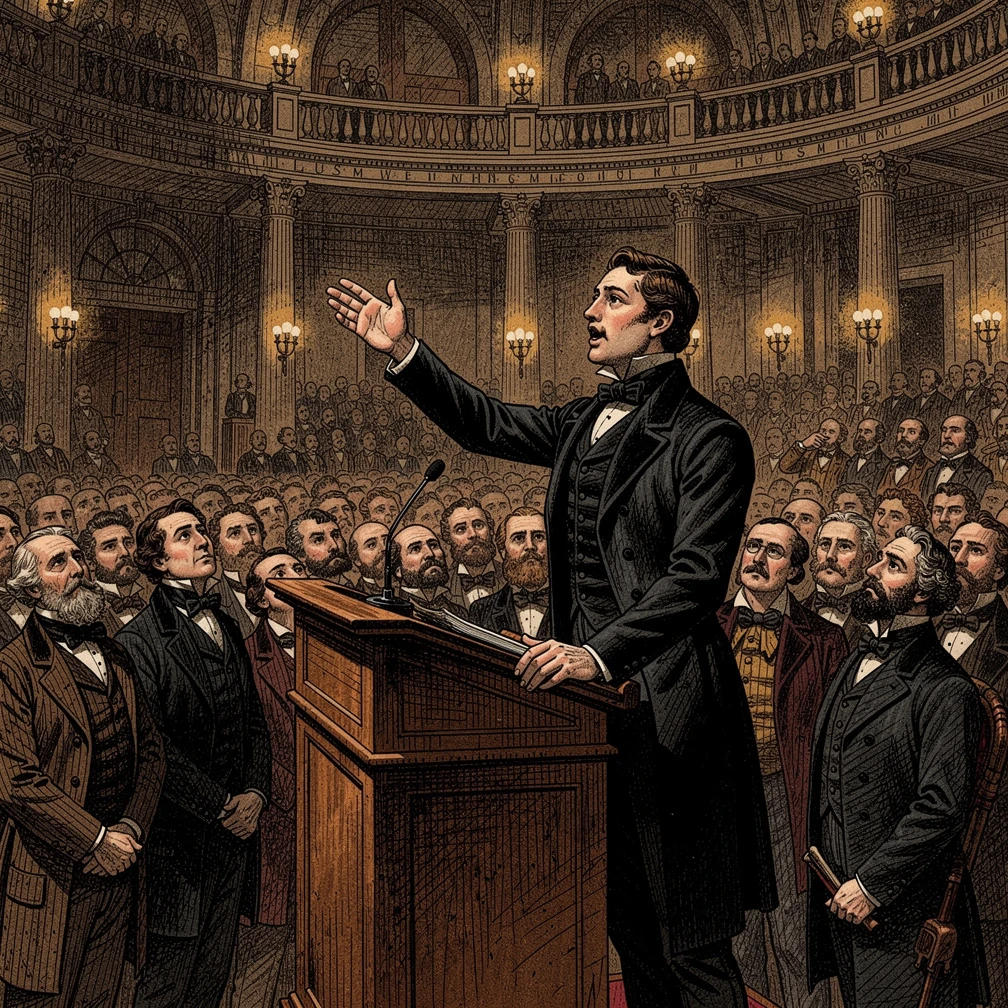
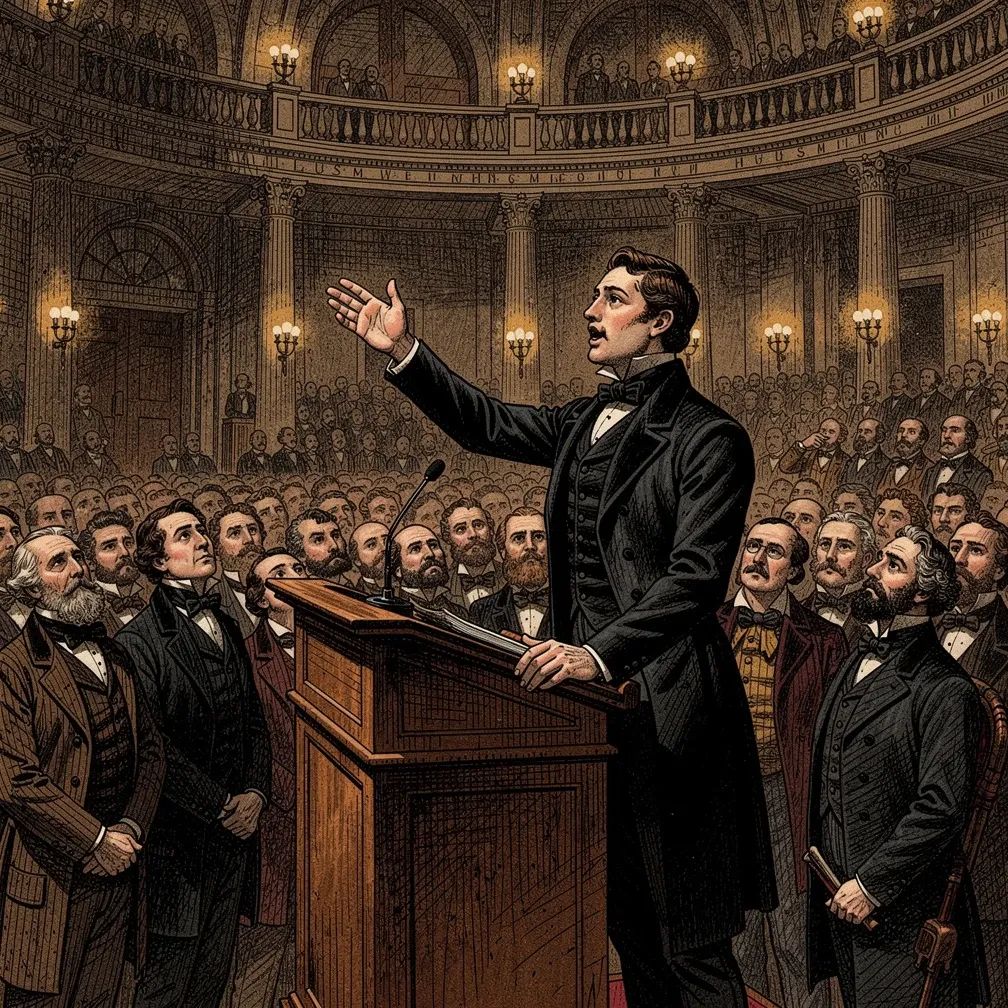
The following address was delivered by Thomas Francis Meagher, Esq., at the Rotunda, Dublin, on the 15th day of July, 1847, before an assembly of the Irish Confederation. It is here reproduced in full, being a true and accurate record of the address as delivered. Copies may be obtained at the offices of the Nation newspaper, D'Olier Street, Dublin.
AN ADDRESS ON THE QUESTION OF MORAL AND PHYSICAL FORCE
Delivered by Thomas Francis Meagher, Esq.
I have been asked to speak tonight on the question of the sword. I will do so plainly, because plainness is the only language adequate to the moment in which we are gathered.
Eight months ago, a Parliamentary committee in Whitehall voted to strip the Irish people of their last protection. Not their last comfort. Not their last luxury. Their last protection — the fraction of soil between a family and the grave. Any land at all disqualifies you from relief. Any land at all. A strip of garden; a patch of ground sufficient to bury your dead; a threshold. Surrender it, or starve. These are the terms of the Treasury memorandum that now has the force of law.
I have read that memorandum. It is a careful document. It is the work of a careful man. It speaks of agricultural consolidation, of economies of scale, of the costs to the consolidated fund. It is not written in cruelty. That is the first thing to understand about it. It is written in a tone of settled, satisfied reason — the tone of a man who has done his arithmetic and found the numbers satisfying. The people of Ireland do not appear in it as human beings. They appear as a variable. They appear as an expense. They appear, in the language of Mr. Senior's appended memoranda, as a surplus requiring correction.
I want you to sit with that word. Surplus. It is the word that the political economists use when they wish to say: there are too many of you, and the market will correct this, and this correction is not our business to prevent.
How many have died since October? The figures from Connacht alone — I will not recite them here, because the recitation does no justice to what each number contains. I will say only that the figure is large enough that Mr. Trevelyan, writing in the quarterly review in the spring, described the corrective process as proceeding satisfactorily. Satisfactorily. The correction is proceeding satisfactorily.
The constitutional argument — that argument which has occupied the best men of this island for two generations — runs as follows. You petition. You demonstrate. You persuade. You elect. You trust that the Parliament in Westminster, given sufficient evidence of Irish suffering and Irish capacity, will extend to Ireland the rights of a free people. Daniel O'Connell spent his life on that argument. He was the greatest Irishman of his age. He could fill this hall ten times over. He is dead, gentlemen. He is dead and buried three months, and the Parliament in Westminster has responded to his life's work by passing a law that defines the Irish people as a surplus.
I will not insult his memory by pretending the constitutional argument has not received its answer.
Some of my friends urge patience. They say: the thing is done; we cannot undo it now; work within the law; wait for a better hour. I respect those friends. I have argued their position myself, in this room, in this year. I no longer believe it.
Here is what I believe.
I believe that a people who have been told by their government that their lives are an inconvenience have the right — not merely the right, the duty — to say: you are wrong. I believe that a government which defines a people as surplus has forfeited its claim to that people's obedience. I believe that there are circumstances — and gentlemen, I am looking at those circumstances from this platform tonight, you are sitting in the middle of those circumstances — in which the argument of the sword is not the argument of desperation but the argument of dignity.
There are men in this room who will say I am leading you to ruin. They may be right. The British Army is not an abstraction. The cells in Kilmainham are not an abstraction. The ships at Cobh — I know what those ships carry, I have stood on that quay — those ships are not an abstraction. I do not come before you tonight with promises of easy victory. I come before you tonight because I will not stand in this room, in this year, before this assembly, and tell you that the thing which is happening to Ireland is a thing to be endured in silence.
It is not.
A man may be stripped of his land. He may be stripped of his means. He may be stripped of everything the Treasury memorandum and the Poor Law and the Gregory Clause can take from him. There is one thing they cannot take. And it is the one thing they are most afraid of, which is why the memorandum does not mention it and why Mr. Trevelyan's correspondence does not mention it and why the Parliamentary debates on the subject circle around it without ever naming it directly.
They are afraid that you know you are not surplus.
They are afraid that you know the accounting is wrong.
Take up the sword, gentlemen — not because victory is certain, but because the argument that you are nothing is one that you have the power to refuse. Take it up not for victory but for the record that will outlast this moment: that the people of Ireland, in the year of their worst humiliation, did not accept the designation. That they stood. That they said: your arithmetic does not contain us.
History will not forget a people who fought. It has already forgotten a thousand peoples who waited.
I have spoken plainly. I am done.
The foregoing address was printed at the request of the Irish Confederation, Dublin, July 1847. Price: One Penny. The editors of the Nation take full responsibility for its publication.