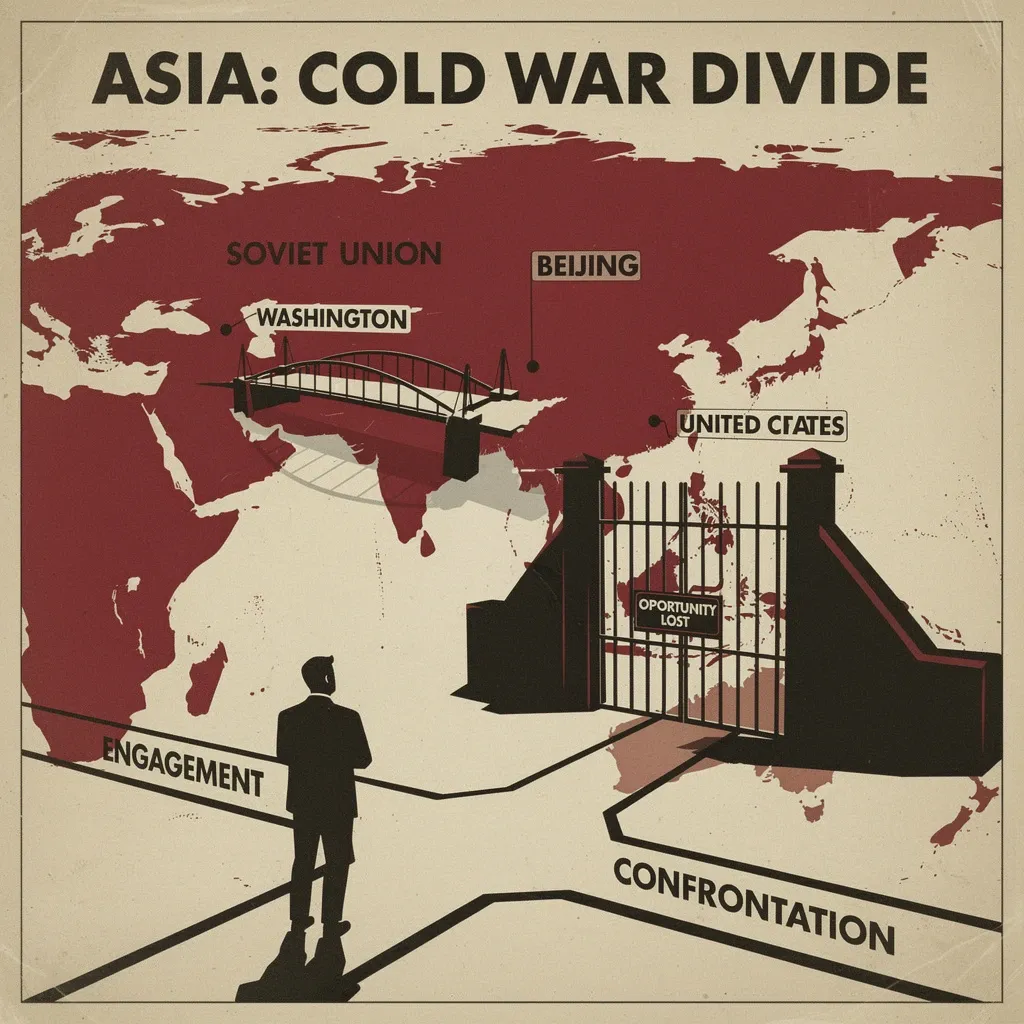
From the journal Foreign Affairs, Spring 1973. The author is identified as a former senior official in the State Department's Policy Planning Staff.
There is a particular kind of strategic mistake that is invisible until it isn't — the kind that produces no immediate crisis, no obvious failure, no headline to mark the moment when the choice was made. The United States' failure to normalize relations with the People's Republic of China is that kind of mistake. It will be felt for a generation. We are only beginning to understand what it cost.
This is not a partisan argument. It is a structural one. The opportunity that presented itself between 1969 and 1972 was not created by any single American administration — it was created by geography, ideology, and the internal logic of a Sino-Soviet relationship that had been fracturing since the late 1950s. The question before American foreign policy in those years was simply whether we would exploit that fracture or leave it to close on its own. We left it. The consequences are now compounding.
The Nature of the Opportunity
The Sino-Soviet split was, by the time of the Johnson second term, a fact of international life that required no intelligence to confirm. The 1969 border clashes along the Ussuri River — in which Soviet and Chinese forces exchanged fire in the most serious military confrontation between the two powers since the Korean War — were public knowledge. Chinese military doctrine had shifted to treat the Soviet Union as the primary threat. Mao Zedong had spent the better part of a decade positioning the People's Republic as the authentic voice of revolutionary Marxism against what Beijing characterized as Soviet revisionism. The two great communist powers were not allies. They were, in most meaningful senses, adversaries.
The strategic implication of this reality was one of the most significant opportunities in postwar American foreign policy. A genuine triangle — in which the United States maintained productive, if not warm, relations with both Moscow and Beijing — would have forced the Soviet Union to calculate its strategic posture against two fronts simultaneously. It would have given Washington leverage in both directions. It would have accelerated the incentives for Soviet accommodation in Europe, in arms control, and in the various regional proxy conflicts that continued to drain American attention and resources through the late 1960s and early 1970s.
None of this required ideological concession. Engagement with the People's Republic of China was not an endorsement of Mao's government or its domestic practices. It was a recognition of a geopolitical reality that already existed and would continue to exist regardless of American preferences. The question was whether the United States would act on that reality or allow ideology to prevent it from doing so.
We allowed ideology to prevent it.
Why It Did Not Happen
The failure is not easily assigned to any single actor or decision. President Humphrey is not, by temperament or conviction, a realpolitiker. He came of age politically in the era of containment as a moral project — the defense of free peoples against communist expansion — and he has never fully separated the strategic from the ethical in his approach to foreign policy. This is not a criticism of his character. It is a description of his formation. He is a good man who finds it genuinely difficult to treat a government that has killed tens of millions of its own citizens as a useful strategic partner, regardless of what that partnership might purchase in Moscow.
Secretary of State William Rogers has been, on this question, broadly in agreement with the President. The State Department's professional cadre — those of us in Policy Planning who watched the Ussuri River clashes with the close attention they deserved — argued internally for a more flexible posture. We did not prevail. The political calculus, as it was explained to us, was that any administration that appeared to be "recognizing" Communist China would face domestic consequences severe enough to outweigh the strategic benefits. The American right was already suspicious of Humphrey's Vietnam settlement. A China opening would have provided his opponents — including an increasingly restless Ronald Reagan — with a reliable cudgel.
There is something to this argument. There is also something deeply frustrating about a foreign policy constrained not by what is strategically sound but by what is domestically survivable. The two have always been in tension. Under the present circumstances, the tension has been resolved consistently in favor of the domestic.
What Has Been Lost
The Soviet Union, as of this writing, has no strategic reason to modify its behavior. It faces no significant pressure from its eastern flank. The Sino-Soviet rift is real but, from Moscow's perspective, manageable — the Chinese are difficult neighbors but not an existential threat, not in alliance with the Americans, not a factor that changes the fundamental correlation of forces. The USSR can afford to be patient on arms control because it is not being squeezed. It can afford to be assertive in the Middle East, in southern Africa, in Southeast Asia, because there is no counterweight on its eastern border that it needs to worry about.
The détente that might have been — a genuine relaxation of Cold War tensions, anchored by a triangular strategic architecture that gave Moscow real incentives to accommodate American interests — has not materialized. What we have instead is a bilateral relationship with the Soviet Union that is marginally less hostile than it was in 1960 but structurally unchanged. SALT I produced an agreement on offensive nuclear weapons that is valuable but insufficient. The Soviets continue to expand their conventional capabilities in Europe. They continue to probe the boundaries of American tolerance in the developing world. They do this because they can.
The China card, as it was called in internal discussions, would not have solved these problems. There is no single diplomatic move that ends the Cold War or redirects Soviet behavior across the board. But the triangular pressure it would have created was real, and its absence is also real, and both are now visible in the strategic landscape in ways that were not visible when the choice was made.
The Irony Worth Naming
There is a dimension of this failure that I find almost too painful to articulate directly, but I think it requires articulation.
Lyndon Johnson's decision to remain in the 1968 race — the choice that set the terms for everything that followed — was made, in part, by a man who believed that withdrawal from Vietnam would mean a communist victory, and that a communist victory in Vietnam would embolden communist powers elsewhere, and that his responsibility as President was to prevent that emboldening at whatever cost. He was, in this, entirely sincere. He hated the idea of losing. He hated the idea of the men who had died in that country dying for something that was then abandoned. He believed the domino theory not as a rhetorical device but as a description of how the world actually worked.
The outcome of his decision — and of the decisions that followed from it, including Humphrey's ideological resistance to engaging Beijing — is that the Soviet Union has been, for the past four years, operating in a more favorable strategic environment than it would have faced if the Nixon-Kissinger triangulation strategy had been executed. The great communist adversary that Johnson was determined not to lose to has been, in a meaningful structural sense, advantaged by the choices made in the wake of his staying.
This is not a condemnation of the man or the choices. History does not arrange itself into clean moral lessons. But it is an irony that serious people in this city understand, and that the historical record deserves to capture clearly before the full weight of it is felt.
We chose to keep our principles and forgo the leverage. The leverage mattered. We will be discovering, in the years ahead, precisely how much.
The author served in the State Department from 1961 to 1972 and is currently a senior fellow at the Council on Foreign Relations. The views expressed are his own.