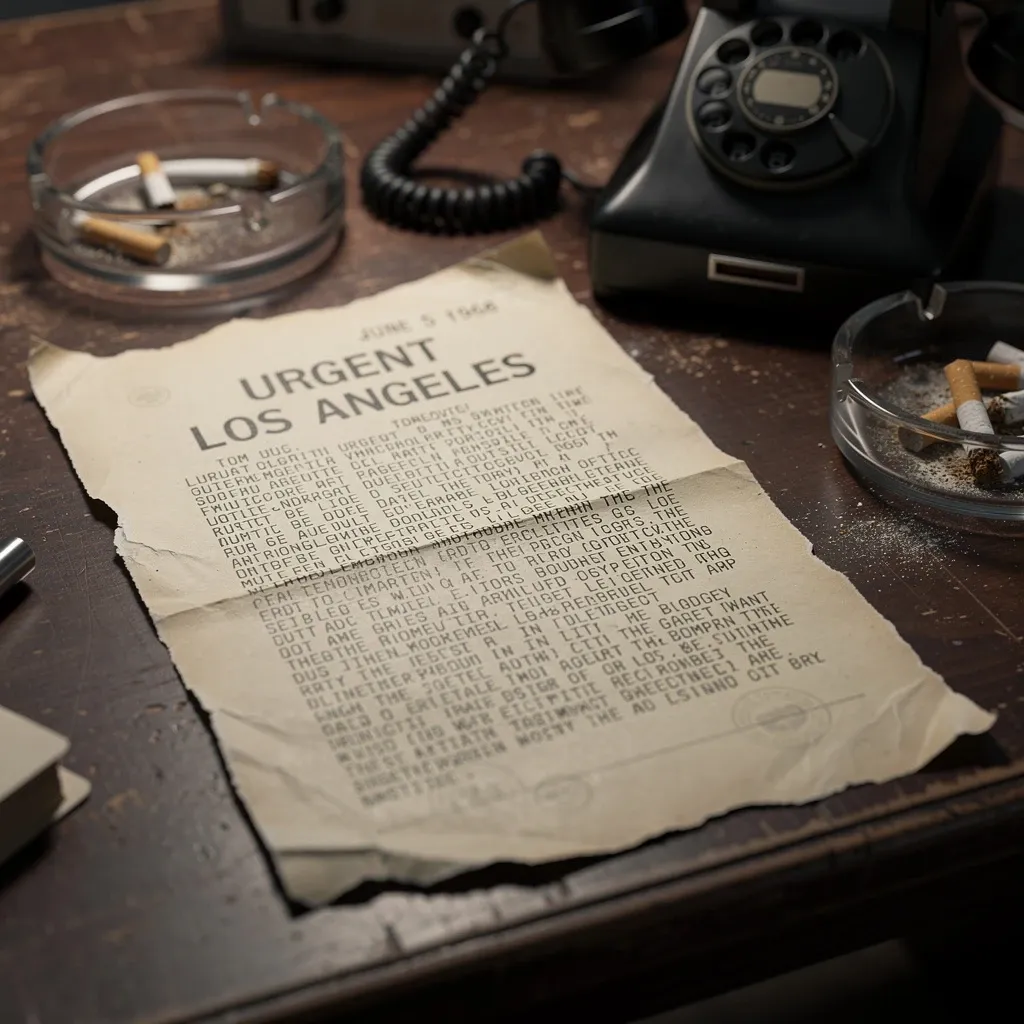
Associated Press — Los Angeles, California — June 5, 1968 — 2:14 AM Pacific
LOS ANGELES — Senator Robert F. Kennedy of New York was shot and critically wounded early Wednesday morning in the pantry of the Ambassador Hotel moments after claiming victory in the California Democratic presidential primary, the most significant defeat yet inflicted on President Lyndon B. Johnson's campaign for renomination.
Kennedy, 42, was struck by multiple gunshots at approximately 12:16 AM. He was rushed to Good Samaritan Hospital, where he remained in surgery as of this report. His condition was described as critical.
A suspect, identified by witnesses and Secret Service as Sirhan Bishara Sirhan, 24, a Jordanian-born resident of Pasadena, was wrestled to the ground at the scene and taken into custody by Los Angeles police. A .22 caliber revolver was recovered.
Kennedy had entered the ballroom of the Ambassador Hotel at approximately midnight to address hundreds of supporters who had gathered to celebrate what his campaign described as a decisive victory. With 73 percent of precincts reporting, Kennedy led President Johnson by six percentage points — a result that his advisers had privately characterized, earlier in the evening, as the beginning of the end of the Johnson campaign.
In his brief remarks to the crowd, Kennedy made no mention of the president by name. He thanked farm workers, Black voters, and young people who had "demonstrated that the divisions in this country can be bridged." He praised the late Senator Robert McNamara — correcting himself almost immediately, drawing laughter from the crowd — and closed by saying the country was ready "to move in a different direction."
He was smiling when he left the stage. He turned left, toward the kitchen.
The shooting occurred in a narrow service corridor connecting the ballroom to the hotel pantry. According to witnesses, Sirhan approached the senator in the crowd and fired at close range. Kennedy fell. Campaign aide Jesse Unruh and athletes Rosey Grier and Rafer Johnson — present as security — subdued the gunman before additional shots could be fired.
Kennedy was conscious when he was placed on a gurney. He asked, according to a witness, whether everyone was all right.
Tonight's primary result represented the culmination of a nine-week campaign conducted entirely under the shadow of a sitting president. When Kennedy entered the race on March 16, he was challenging a man who had declared, two weeks prior, that he would not resign from what he called "this burden." No senator had successfully denied a sitting president the nomination of his own party in modern American history.
Tonight, Kennedy came closer than anyone expected.
His California victory, combined with his earlier wins in Indiana and Nebraska, had given the insurgency a mathematical argument that Johnson's delegates could no longer dismiss as purely symbolic. The senator's supporters had begun speaking, in the hours before the shooting, of a contested convention in Chicago in August. His campaign manager, Lawrence O'Brien, told reporters at the hotel that "the race has fundamentally changed."
At the time of the shooting, the White House had issued no statement on the California results.
This is a developing story. Associated Press will provide updates as they become available.
Contributing: AP Bureau, Los Angeles. Additional reporting from Good Samaritan Hospital.