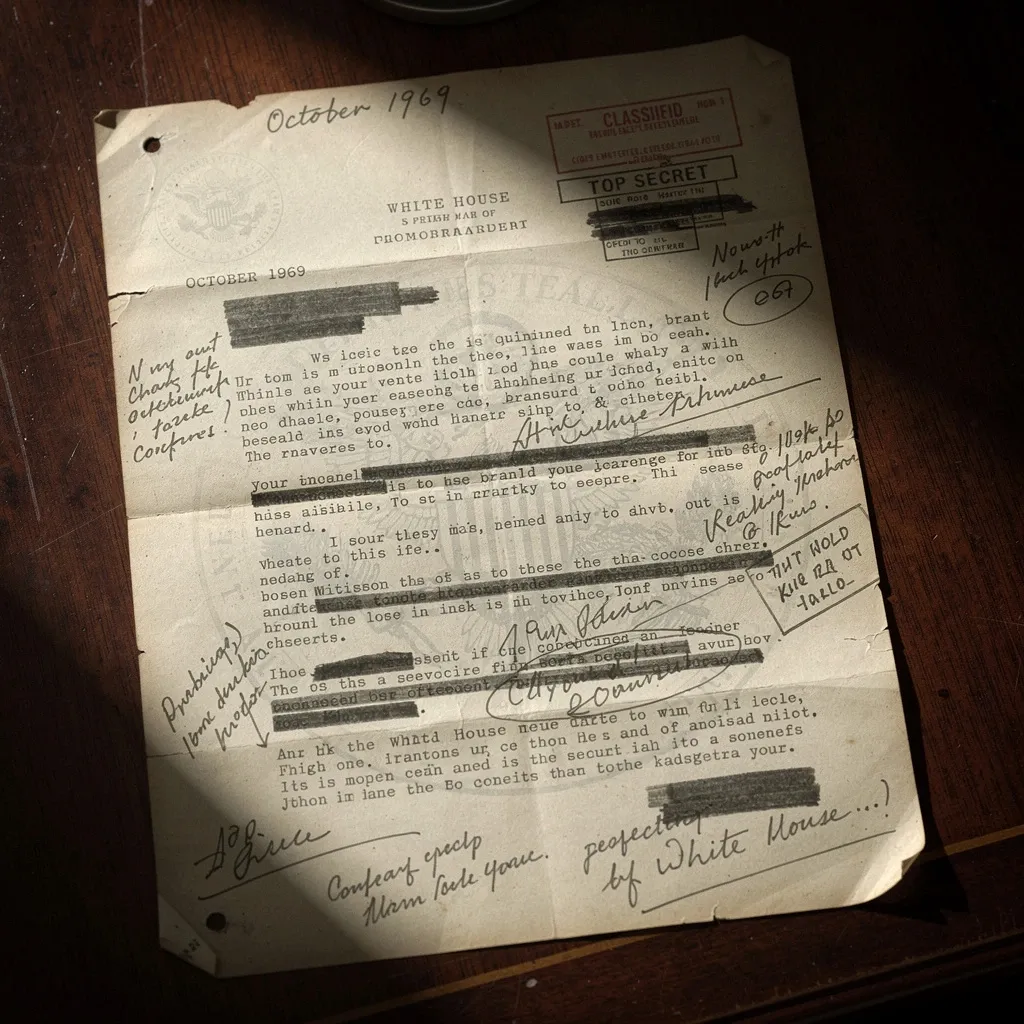
THE WHITE HOUSE
WASHINGTON
NATIONAL SECURITY MEMORANDUM
CLASSIFICATION: TOP SECRET / EYES ONLY
TO: The President
FROM: W.W. Rostow, Special Assistant to the President for National Security Affairs
DATE: October 17, 1969
RE: Vietnam: Assessment and Options, Post-Moratorium
SITUATION SUMMARY
The October 15 Moratorium produced the largest single-day domestic protest in American history by most credible estimates — in excess of two million participants across more than 200 cities. Intelligence assessments indicate the November Moratorium is likely to be larger. Congressional mail is running approximately 8-to-1 against continued prosecution of the war.
In theater, the military situation is as follows. Sustained bombing operations against supply routes in Laos and Cambodia have degraded but not severed NVA logistics. MACV estimates enemy combat effectiveness in the South has been reduced by approximately 18 percent since January 1969. General Abrams continues to request authorization for expanded ground operations into Cambodia. The Joint Chiefs support this request.
Casualties for the calendar year 1969 are projected to exceed 11,000 American dead.
[Handwritten, margin: What does 18% buy us? — L]
OPTION A: ACCELERATED MILITARY PRESSURE
Authorize expanded ground incursions into Cambodia and Laos. Intensify bombing of Hanoi and Haiphong port infrastructure. Provide MACV with the resources requested to pursue a decisive military result by spring 1970.
Assessment: Military advisers believe this approach carries a 40-50% probability of achieving a negotiated settlement on favorable terms within 18 months, contingent on Hanoi's willingness to negotiate under duress. Political cost domestically is assessed as severe. Allied support in Europe is likely to deteriorate further.
[Handwritten, margin: They've been saying 18 months for four years. — L]
OPTION B: VIETNAMIZATION FRAMEWORK
Begin systematic transfer of combat responsibility to ARVN forces on an accelerated timeline. Set a schedule — to be determined — for staged American troop withdrawal. Maintain air support and advisory capacity. Frame this publicly as fulfillment of the mission, not retreat.
Assessment: ARVN combat readiness remains, in the view of the Defense Department, insufficient to hold the South without American ground presence for a minimum of three to five additional years of development. A premature withdrawal schedule risks collapse of the Saigon government. This option requires accepting that outcome as a possibility.
[Handwritten, margin: I will not be the president who handed them a white flag to carry. Crossed out. I will not let those boys have died for — Crossed out. Incomplete sentence.]
OPTION C: ACCELERATED NEGOTIATION
Authorize Ambassador Lodge to make substantive concessions at Paris sufficient to produce a framework agreement. Accept a coalition government in Saigon as a possible transitional outcome. Seek an agreement before the end of calendar year 1969.
Assessment: Hanoi's current negotiating posture suggests they believe time favors them. Meaningful concessions may produce an agreement, or may be interpreted as weakness and harden their position. This option requires accepting political accountability for the terms of the settlement.
[Handwritten, margin: What does Harriman think? Get me Harriman.]
[Second notation, same margin, different ink, possibly later date: Don't. — L]
ROSTOW NOTE: Mr. President, you have asked me twice in the past ten days to "find the door." I want to be direct with you: I do not believe there is a door that does not require accepting something we have said we will not accept. The options above are not good options. They are the options. I recommend we meet before the end of the week.
[Handwritten, across the bottom of the final page, in large letters: I know there is no door. I built the room. — L]
This document was declassified in 1987 under the Freedom of Information Act and is held in the Lyndon Baines Johnson Presidential Library, Austin, Texas. The handwritten annotations are authenticated as the President's. Johnson died at the White House on November 14, 1969, twenty-eight days after this memorandum was written.