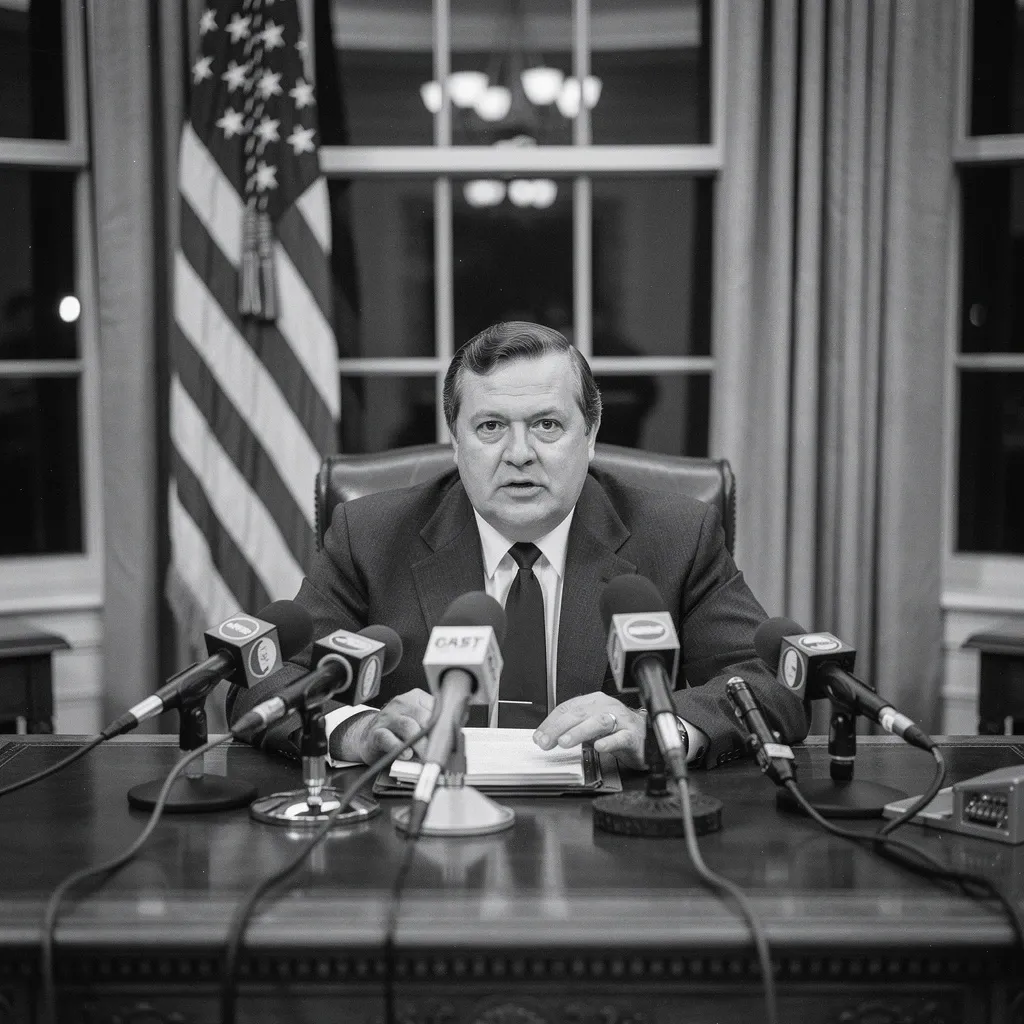
Address to the Nation by President Hubert H. Humphrey. Delivered from the Oval Office, Washington, D.C., December 11, 1971.
Good evening.
Earlier today, in Paris, Ambassador Ellsworth Bunker signed a framework agreement with representatives of the Democratic Republic of Vietnam, the National Liberation Front, and the Government of the Republic of Vietnam. The agreement provides for an immediate ceasefire along all active fronts, the staged withdrawal of remaining American combat forces over a period of ninety days, the exchange of all prisoners of war, and the establishment of an international commission to monitor compliance.
American involvement in the ground war in Vietnam is over.
I will not tell you tonight that this is a moment of triumph. I do not believe it is, and I think you would not believe me if I said so. Too many men died in that country — 58,000 Americans, and uncounted Vietnamese on all sides — for anyone to stand before you and declare a victory. What we have achieved is an end. An honorable end, I believe, and one that gives the Vietnamese people a chance to determine their own future. But an end, not a victory, and I want to be precise about that because I think the American people deserve precision tonight more than they deserve comfort.
What I can tell you is this: the men and women who served in Vietnam served their country with courage and with discipline under conditions of enormous difficulty and in the face of a war that divided the country that sent them. They deserved to come home sooner. All I can offer them now is the promise that they are coming home, and that what they did will be remembered, and that the country they served is grateful — more grateful than it has always known how to say.
I want to speak for a moment about Lyndon Johnson.
President Johnson inherited the structure of this war from his predecessors and then made it his own — made it larger and more costly than it needed to be, I think, in ways that history will judge. I was his Vice President. I know what he believed about this war and I know what it cost him personally and I know that the decisions he made were made by a man who was trying, with everything he had, to protect the country he loved from what he saw as a genuine and present danger. He was not dishonest about his intentions. He was wrong about the means. There is a difference, and I think it matters.
He died without seeing this day. He died still carrying the weight of a war he could not find the way out of. I have thought about him often during these negotiations — about what it would have meant to him to know that the men he sent to fight could finally come home. I hope, wherever he is, that he knows.
The work ahead is not small. We have obligations to the Republic of Vietnam that we must honor fully and consistently. We have obligations to our veterans that we have not yet fully met. We have obligations to one another, as a country that has been arguing about this war for a decade, to find our way back to something like a common understanding of who we are and what we owe each other. None of that is simple. None of it happens tonight.
But the dying stops tonight. That is not nothing. After everything this country has been through, that is not nothing at all.
Thank you, and good night.
The address lasted eleven minutes. Approval ratings for President Humphrey rose fourteen points in polling conducted in the following week. A national day of remembrance for Vietnam veterans was observed on December 20, 1971.