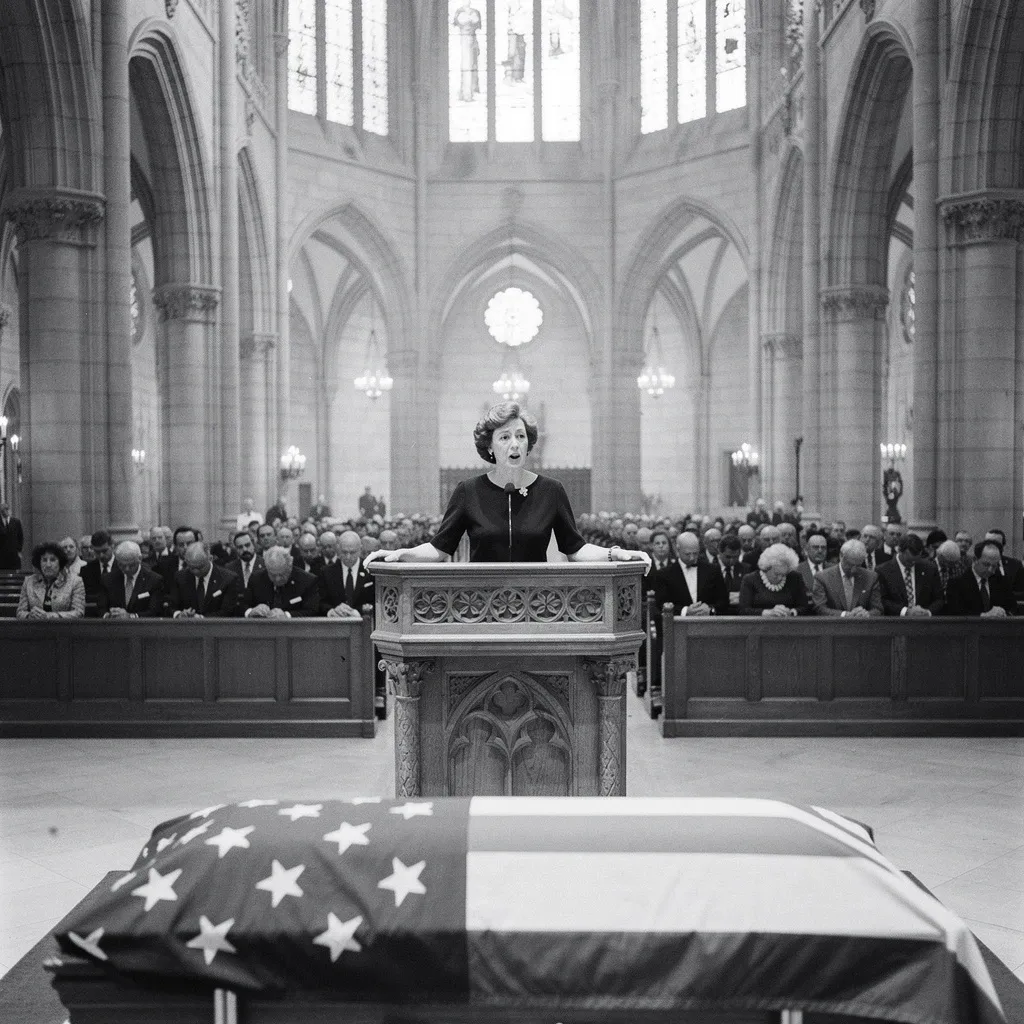
Delivered by Mrs. Lyndon Baines Johnson at the State Funeral of President Lyndon Baines Johnson, Washington National Cathedral, Washington, D.C., November 18, 1969.
There is a yellow legal pad in the Oval Office that I have not been able to bring myself to move.
Lyndon used yellow legal pads for everything that mattered. Speeches, letters, calculations he was too private to share with staff, arguments he was working through alone. He covered them in his large, certain handwriting, and when he was finished he either put them in a drawer or threw them in the wastebasket, depending on whether the idea had survived contact with the page. He trusted the pad more than he trusted most people. He said once that a yellow legal pad never looked at you like it thought you might be wrong.
The one I have not moved contains the last revision he made to his March 31, 1968 address. He had written something. He crossed it out. He wrote one sentence in its place. That sentence was the last thing he said to this country before he said good night, and it was the truest thing he ever said in public, and I am going to be living with it for the rest of my life.
I do not intend to describe what is on that pad. Some things belong to the man they came from. But I will tell you what I believe about the sentence he chose to deliver, because I think it has been misread, and I think he would want it understood correctly.
People have called it defiance. People have called it stubbornness. People who did not know him have called it pride. It was none of those things, or rather, it was all of those things and something larger than all of them combined. What Lyndon Johnson said on the night of March 31, 1968, was not a political statement. It was a declaration of what he understood his life to mean. He was a man who believed that the work of a country never ends and that the obligation to do it does not diminish because it becomes hard. He had been given the largest legislative project in American history, and he had built it, and he was not finished, and he knew it, and he said so. In the plainest terms he could find.
He kept the promise. I want that said plainly and on the record. He was offered — by his doctors, by his staff, by his own body, which was failing in ways only a few of us knew — every possible exit from the burden he had taken on. He refused each one. He worked through the protests. He worked through the grief of the King assassination and the grief of the Kennedy assassination and the grief of every casualty list that crossed his desk, and there were thousands of them, and he read every name because he believed that was what it meant to send men to their deaths — that you did not look away from what you had done. He did not sleep enough. He did not rest enough. He did not take care of himself in any of the ways I spent a decade asking him to. He was, in that sense, exactly the man he always was: impossible to redirect once he had decided where he was going.
He was also the man who passed the Civil Rights Act. Who passed the Voting Rights Act. Who signed Medicare into law and stood next to Harry Truman when he did it, because Harry Truman had first proposed it and Lyndon thought that was only right. Who funded more schools and more hospitals and more programs for people who had been told for decades that their government did not see them. He did all of that. It is there. It cannot be taken back. Whatever else is said about him, and I know much else will be said, that is what he built, and it is built, and it will stand.
In his second inaugural address, Lyndon spoke about the work that remained. He said he would not rest until the work was done. I remember standing behind him as he said it and thinking that he did not entirely understand what he was promising, because the work of a country like this one is never done, not really, and a man who ties his life to that work has made a commitment with no natural end point. I thought it then and I think it now.
I was wrong to worry. He understood perfectly.
He gave — he gave everything. His health. His sleep. His peace. His certainty, in the last months, that any of it was working. He held on to the work when the work was the only thing left to hold on to, and he did not put it down, and now the work will have to be carried by someone else, by all of us, by the country he loved with a ferocity that sometimes frightened people who did not know where it came from.
I know where it came from. I knew him for thirty-four years. I know what he was made of and what it cost him and what he thought it was worth.
He thought it was worth everything.
He was right.
Mrs. Johnson spoke for approximately fourteen minutes. She did not use prepared remarks for the final portion of her address. She did not cry.