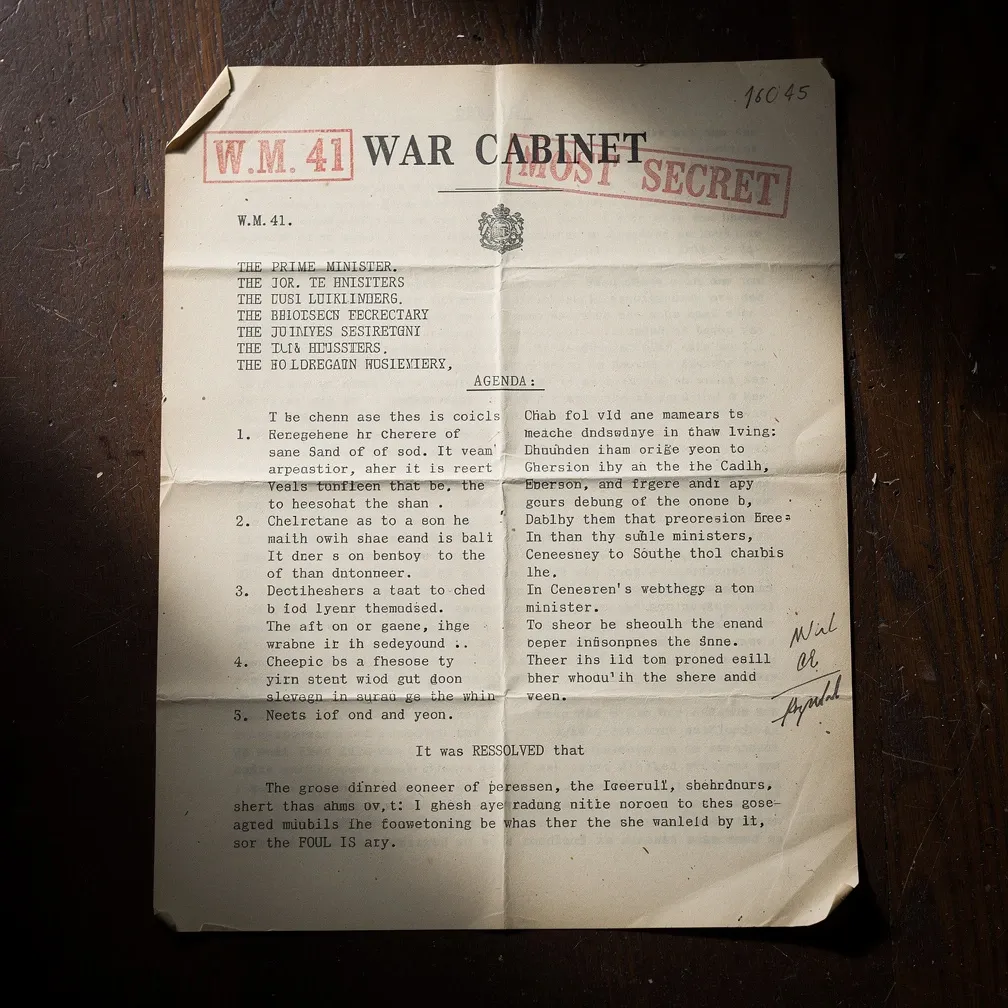
By January 1941, Churchill's War Cabinet had held Britain together through the fall of France, the evacuation at Dunkirk, and four months of the Blitz. In our timeline, the Cabinet never seriously entertained armistice. Churchill had secured that consensus in May 1940, when he outmanoeuvred Halifax in the War Cabinet debates and foreclosed negotiation as a live option. The war continued. Britain held. The rest is known.
In this world, it didn't hold. Edward VIII never abdicated. He never went to the Bahamas. He remained a senior member of the royal family with access, influence, and — crucially — existing back-channels into the German Foreign Ministry through his prewar social circle and the Duke of Windsor's position in Lisbon. When Ribbentrop's office opened a quiet contact in autumn 1940, Halifax received it. When Edward communicated privately to the Cabinet through channels that left no formal record, five men read the same letter and drew their own conclusions.
What follows is Item 7 of the War Cabinet's eighth meeting of 1941, held on the morning of Saturday, 11 January. Items 1 through 6 — supply lines, garrison reinforcement, shipping losses — are summarised in a separately circulated annex. Item 7 is not. It is held under separate cover. It records, in the measured language of Whitehall, the moment five men voted on whether Britain would fight on. Four said no. One asked that his dissent be noted.
The BBC would not announce the armistice for another nineteen days.
WAR CABINET
W.M. (41) 8th Conclusions
MOST SECRET
Minutes of a Meeting held at 10, Downing Street, S.W.1, on Saturday, 11th January, 1941, at 10:00 a.m.
PRESENT
The Right Honourable Winston S. Churchill, M.P.
(Prime Minister, in the Chair)
The Right Honourable Viscount Halifax
(Secretary of State for Foreign Affairs)
The Right Honourable C.R. Attlee, M.P.
(Lord Privy Seal)
The Right Honourable Ernest Bevin, M.P.
(Minister of Labour and National Service)
The Right Honourable Arthur Greenwood, M.P.
(Minister without Portfolio)
IN ATTENDANCE
Sir Edward Bridges, K.C.B. (Secretary to the War Cabinet)
[Items 1 through 6 appear in the separately circulated summary record W.M. (41) 8th Conclusions (Annex A): Committee Reports on North African Supply Lines; Malta Garrison Reinforcement — February Estimates; Merchant Shipping Losses — Week Ending 8th January; Manpower Returns; Home Guard Equipment; Fire Watching (Compulsory Service) Bill — Second Reading.]
7. ARMISTICE PROPOSAL — LISBON BACK-CHANNEL
(Continued from W.M. (41) 4th Conclusions, Minute 9)
The SECRETARY OF STATE FOR FOREIGN AFFAIRS recalled that the Cabinet had received on 4th January a communication transmitted through an intermediary in Lisbon, setting out terms for a cessation of hostilities proposed by the German Foreign Ministry. The Cabinet had agreed at that meeting to receive the communication without commitment and to defer formal consideration pending legal advice from the Solicitor-General and a private communication from His Majesty.
The SECRETARY OF STATE FOR FOREIGN AFFAIRS informed the Cabinet that the Solicitor-General had advised that the Crown retained prerogative authority to enter into armistice negotiations, and that no Act of Parliament would be required to proceed to that stage. The advice was circulated as W.C.P. (41) 12 (Most Secret).
The SECRETARY OF STATE FOR FOREIGN AFFAIRS further stated that a private communication from His Majesty had been received on 8th January and had been read individually by each member of the Cabinet. The communication was not minuted.
The PRIME MINISTER invited members to express their views.
The MINISTER OF LABOUR AND NATIONAL SERVICE stated that he would not oppose the opening of contact, on the understanding that no commitment to any terms was implied by the act of negotiation and that Parliament would be informed at the appropriate time.
The LORD PRIVY SEAL concurred. He observed that the terms as transmitted offered sufficient ambiguity to permit withdrawal at any stage prior to signature.
The MINISTER WITHOUT PORTFOLIO stated that he was prepared to support the opening of contact, provided that the Dominions were informed simultaneously and that knowledge of the communication remained confined to those presently in the room.
The SECRETARY OF STATE FOR FOREIGN AFFAIRS supported the opening of contact. He stated that the military position did not preclude continued resistance, but that the cost of continuation, measured against terms that preserved the Empire and the Fleet, could not be dismissed.
The PRIME MINISTER stated that he was unable to concur. He invited the Cabinet to record his dissent.
THE CABINET AGREED, the Prime Minister dissenting, to authorise the Secretary of State for Foreign Affairs to open contact through the Lisbon channel for the purpose of establishing the basis and procedure for armistice negotiations, without commitment to any terms. The authorisation was to remain Most Secret. A further Conclusions would be circulated when preliminary contact had been established.
The Cabinet was informed that a formal record of this item would not be circulated to the wider Whitehall distribution list and that the present minute would be held under separate cover by the Secretary to the Cabinet.
Certified correct: E. Bridges
10, Downing Street, S.W.1
11th January, 1941