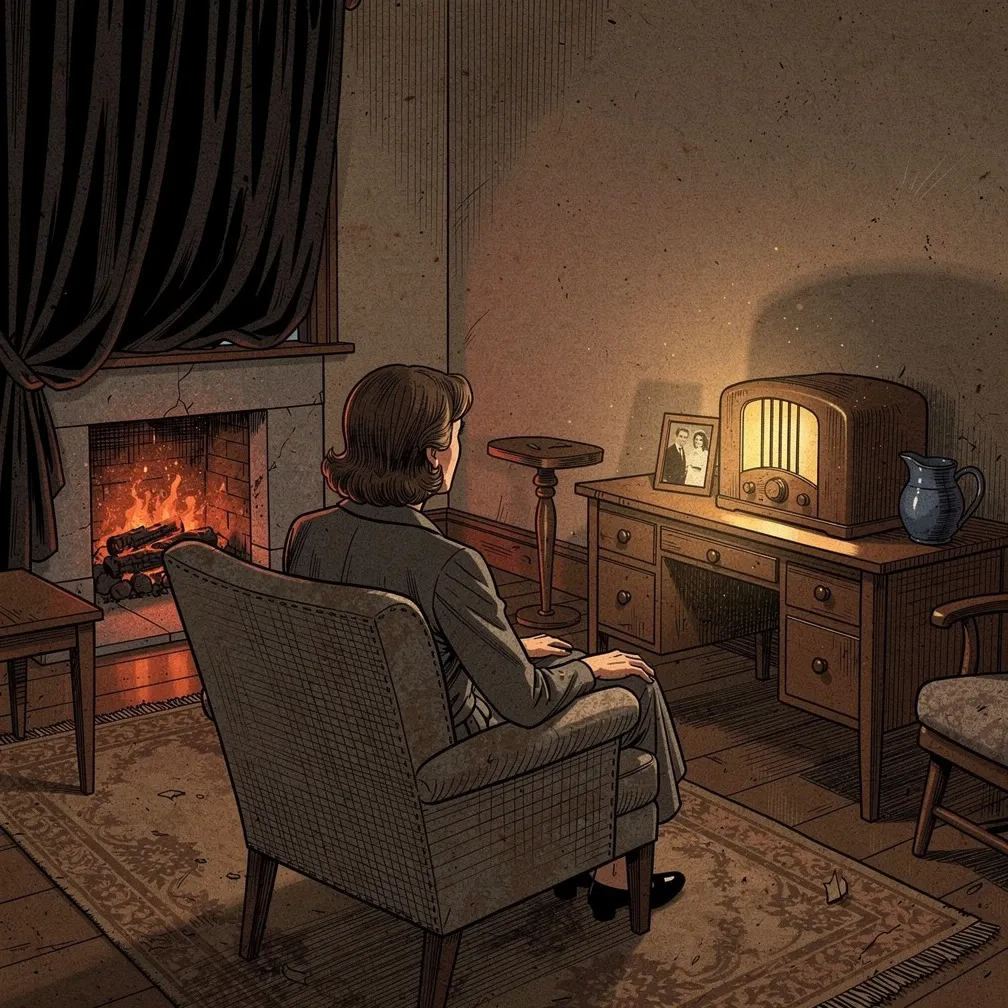
In our timeline, Britain kept fighting. This moment — a country being told the war was over — never happened this way, in January 1941, while men were still in the field and the losses were still raw.
Here, the Peace of Lisbon was signed on the afternoon of 30 January 1941, and the BBC Home Service announced it at nine o'clock that evening. What follows is not about the armistice itself — the politics, the terms, the men who voted for it — but about what it felt like to hear it said out loud, in a Birmingham terrace, in the silence after the wireless spoke.
This story is the mirror to The Last Entry. Where Sergeant Hollis wrote in the heat of August — a crew room, men still alive, something wrong just beginning — Dorothy Sherwood sits in January cold, hearing something wrong end. Both documents stop before the character has decided what they feel. That suspension is the point.
The BBC Home Service that refused to relay the Windsor Broadcast in August is the same BBC that announces its consequence here. The country that heard Edward speak of honourable arrangements is now hearing the arrangement concluded.
Dorothy Sherwood had been expecting it for three weeks. She hadn't told anyone this — not Mrs. Patterson next door, not her sister in Coventry, not the woman at the counter in the post office who would have understood, whose son was in Malta. She hadn't said it because saying it felt like something close to giving up, which wasn't the same as wanting it. She could just see it coming. The way you could see rain if you watched the sky long enough and nobody else was looking.
The wireless sat on the sideboard where it had always sat, between the photograph of Frank at their wedding and the blue jug she'd had from her mother. It was a Pye set, mahogany with a fabric grille, and Frank had bought it secondhand from the man two doors down in 1938 when everyone said there was going to be a war. She switched it on at half past eight and sat in the good chair and waited. Outside, the blackout curtains were drawn. She had stopped thinking about why. It was just what you did at nightfall now, same as locking the door.
The nine o'clock programme had not yet started when the announcement came.
This is the BBC Home Service. Here is an announcement.
She set down her tea.
His Majesty's Government wishes to inform the public that an Instrument of Armistice between Great Britain and Germany was signed today at Lisbon at three o'clock in the afternoon.
Today. She turned the word over. Today at three o'clock. It was half past nine now. Six and a half hours ago, the war had ended. She had spent those six and a half hours not knowing it — had queued at the butcher's, had written a letter to Frank that she hadn't posted yet, had eaten her tea alone at the kitchen table. The war had ended while she was washing her plate. She found she didn't know what to do with this information.
Hostilities between British and German forces have accordingly ceased.
Alan had been killed on the second of September. He'd flown Hurricanes out of Biggin Hill. He was twenty-two years old and he'd been to Germany twice before the war on a cycling holiday with a school friend, and he'd written home that the Germans were perfectly decent once you got away from the cities. She had kept that letter. She didn't know why she'd kept it, but she had.
She sat with it now — the image of Alan cycling through Germany, laughing at something, the way he always laughed slightly before the joke was finished because he couldn't help it — and she thought: he was right, and he came home and told her, and three years later he died proving it.
The war had started in September of '39. It had ended today. In between: Alan. In between: the raids, the rationing, the telegrams, the not-sleeping. In between: Frank shipped to North Africa in October, his last letter arriving December fifteenth, six weeks ago, postmarked somewhere outside Tobruk. In between: all of it, which had apparently added up to an afternoon in Lisbon, three o'clock, and a voice on the wireless saying it was over.
She understood, dimly, that she should feel something definite about this. Relief, or grief, or shame. Instead she felt all of them at once and none of them clearly, like several wireless stations playing simultaneously into the same room.
The terms of the Armistice provide for the preservation of British sovereignty and the integrity of the United Kingdom.
Sovereignty. She turned the word over the way she'd turned over today. Alan had preserved something. He'd preserved it from the second of September until whenever the actual decision was made — November, December — when the men in the rooms had already concluded what she'd been watching coming for weeks. She was not, she told herself, accusing anyone. She was only doing arithmetic.
His Majesty's Government will make a full statement to Parliament in due course.
She thought about Frank. He was alive — she believed this, she had to believe this, the alternative was not available to her — alive somewhere outside Tobruk on an evening in January when the war had just ended. He didn't know yet. He was sitting wherever soldiers sat at half past nine, and the war was over, and he didn't know it.
He might be home by spring.
The thought arrived so suddenly she nearly laughed. She pressed it down. It wasn't — she wasn't going to —
Alan was not coming home by spring.
She put her hands flat on her knees and looked at the sideboard. The photograph of Frank. The blue jug. The wireless that had been bought because there was going to be a war and had now outlasted it.
The Prime Minister, Lord Halifax, will broadcast to the nation tomorrow evening at nine o'clock.
Halifax. She knew the name. She'd seen his face in the newspaper — long, careful, the expression of a man measuring every word before he said it. She knew that he was the Prime Minister now, which meant he was the man who had done this, or at least the man whose name was on the doing of it, which was what counted when you were trying to decide where to put what you were feeling.
She found, to her surprise, that she was angry. Not the shapeless exhausted feeling she'd been managing for four months but something sharper, directional, pointed at Halifax's careful newspaper face. Alan had died on the second of September. Halifax had been in the Cabinet in September. In October. In November, when the peace faction grew stronger. She had read about the diplomatic back-channels in careful, hedged newspaper language, and she had known — in the way she knew things she didn't say aloud — that it was going one way.
She let the anger sit there for a moment. It was almost a relief, having something to feel that wasn't the other thing.
Then it slid away, because she was too tired to sustain it. Halifax was going to broadcast tomorrow and explain it, and the explanation would be careful and measured and it would make a certain kind of sense, and she would read it in the paper and understand it and still feel this, underneath, where the arithmetic lived.
Members of the public are advised that no immediate action is required on their part.
She did laugh then, just briefly, just a small sound in a quiet room. No immediate action. She looked around: the sideboard, the wireless, the blue jug, Frank's photograph. The coal scuttle. The blackout curtains she had stopped thinking about. No immediate action. As if she had been crouched behind something all this time, waiting for the signal to move.
She got up and put coal on the fire.
When she sat back down, the wireless was playing music. She didn't recognise what it was. She sat and listened anyway, because the quiet was worse, and she wasn't ready for that yet.
Frank might be home by spring.
She let the thought surface again, properly this time, and looked at it. She was allowed to want Frank home. She knew she was allowed this. She just wasn't sure she was allowed to want it this much, this quickly, this cleanly — as if the relief of it could be separated from the rest of it, from the arithmetic, from the second of September. As if you could be glad the war was over without it meaning something about whether the war should have been over sooner.
She held the thought as long as she could. Then she set it down carefully, the way you'd set down something you weren't sure you were allowed to keep.
Outside, it began to rain.